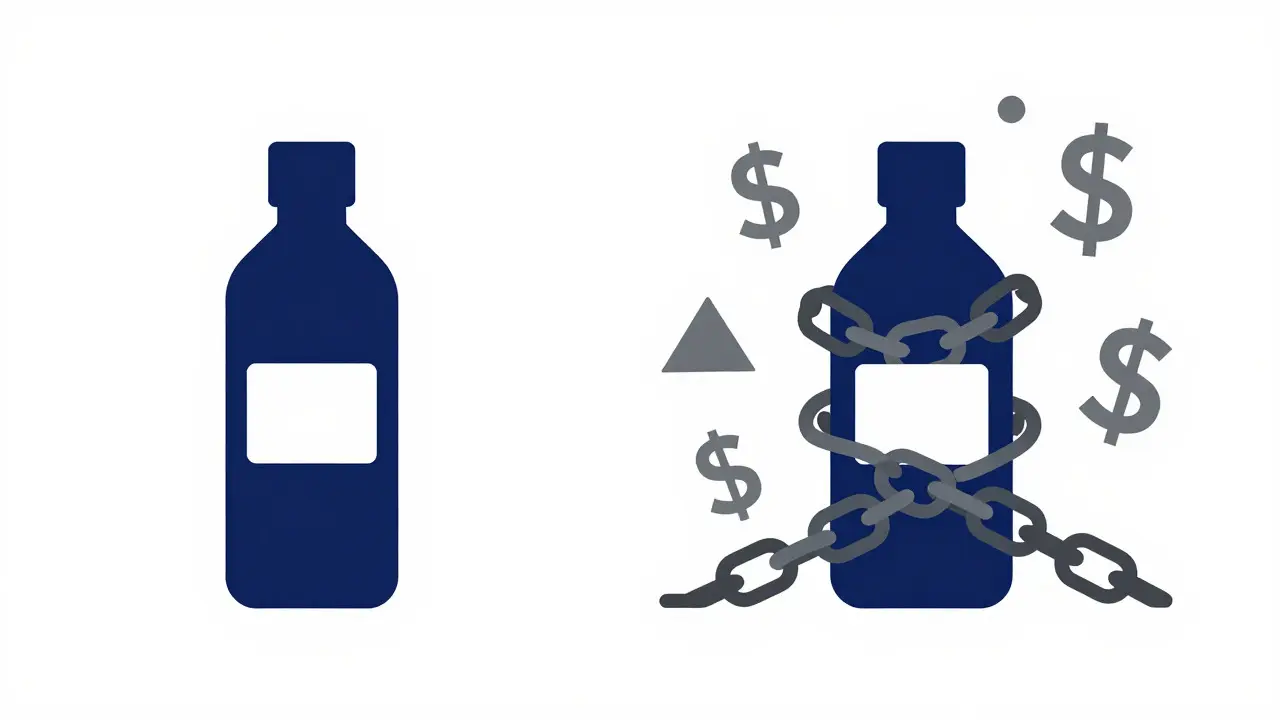
Imagine buying a bottle of water. In one country, it costs $1. In another, just across the border or perhaps on the other side of the ocean, that exact same bottle costs $50. It sounds absurd, right? Yet, this is the daily reality for millions of Americans trying to afford their life-saving medications. You might wonder why the United States, with its advanced economy and massive population, pays significantly more for drugs than any other developed nation. The answer isn't just about greed; it's a tangled web of laws, middlemen, and market structures that have evolved over decades.
As of mid-2026, the situation remains stark. Americans pay more than three times what citizens in other OECD nations pay for brand-name drugs. This isn't a minor difference-it’s a systemic gap that affects everything from your monthly budget to national health outcomes. Understanding why requires looking past the pharmacy counter and into the machinery of how drugs are priced, sold, and reimbursed in America.
The Missing Piece: Government Price Negotiation
Let’s start with the biggest structural flaw in the U.S. system: the government mostly doesn’t negotiate drug prices. In most other developed countries, like Germany, France, or Canada, the government acts as a bulk buyer. They say, "We will cover these drugs for our citizens, but only if you sell them at a price we agree is fair." This is called reference pricing or direct negotiation.
In the United States, however, the Medicare Modernization Act of 2003 specifically prohibited Medicare from negotiating drug prices directly with manufacturers for many years. For over two decades, this created a vacuum where pharmaceutical companies could set prices with little pushback from the largest single payer in the country. While recent changes under the Inflation Reduction Act (IRA) have begun to allow some negotiation starting in 2026, the program is limited. It currently covers only ten high-cost drugs, saving an estimated $1.5 billion annually. Compared to the total market, this is a drop in the bucket.
Without the power of bulk purchasing, the U.S. effectively subsidizes global pharmaceutical profits. According to a White House fact sheet from late 2025, the U.S. accounts for less than 5% of the global population but generates approximately 75% of global pharmaceutical profits. When you don’t negotiate, you pay the list price-or worse.
The Middlemen Maze: PBMs and Rebates
If manufacturers set the price, who decides what you actually pay? Enter the Pharmacy Benefit Managers, or PBMs. These are private companies that sit between insurers, pharmacies, and drug makers. Originally, they were meant to help lower costs by negotiating discounts. But today, their role has shifted dramatically.
PBMs have become vertically integrated giants with immense market power. Here’s the twist: PBMs often prefer higher list prices from drug manufacturers. Why? Because they receive rebates-a percentage of the drug’s cost-based on those high list prices. If a drug costs $1,000 and the rebate is 20%, the PBM keeps $200. If the list price drops to $800, the rebate shrinks to $160. So, ironically, higher sticker prices can mean more profit for the PBM.
This creates a perverse incentive structure. Instead of driving down costs for patients, the system rewards opacity and complexity. A Morgan Lewis analysis from April 2025 highlighted how this lack of transparency shields consumers from seeing the true cost of their care. You see a copay, but you rarely see the full chain of markups and rebates happening behind the scenes.
International Disparities: The Galzin Example
To understand the scale of the problem, look at specific examples. Senator Bernie Sanders’ September 2025 report revealed a shocking case involving Galzin, a medication used to treat Wilson’s disease, a rare genetic condition. In the United States, the annual cost for this drug is $88,800. In the United Kingdom, it costs $1,400. In Germany, it’s $2,800.
That’s a 1,555% markup in the U.S. compared to the UK. This isn’t an isolated incident. The White House confirmed that Americans pay massively higher prices for the exact same pill, made in the same factory, simply because of where they live. This disparity forces patients into impossible choices: skip doses, ration medication, or go into debt.
| Country | Annual Cost (USD) | Price Relative to UK |
|---|---|---|
| United Kingdom | $1,400 | Baseline |
| Germany | $2,800 | 2x UK Price |
| United States | $88,800 | 63x UK Price |
Specialty Drugs and Market Growth
Not all drugs are equally expensive, but certain categories drive the majority of spending growth. Specialty drugs, which treat complex conditions like cancer, endocrine disorders, and rare diseases, are the primary culprits. According to the IQVIA Institute, these drugs drove an 11.4% growth in net prescription drug spending in the U.S. in 2024, up from 4.9% in 2023.
A significant portion of this surge comes from novel obesity and diabetes medications, such as Ozempic and Wegovy. These drugs have expanded into new patient populations, creating unprecedented demand. While they offer life-changing benefits, their high list prices strain insurance plans and out-of-pocket budgets. Even with recent deals announced by the White House in late 2025-claiming to reduce Ozempic from $1,000 to $350 monthly-the overall trend shows continued escalation. IQVIA projects that specialty, endocrine, and cancer drugs will continue to drive expenditures through 2026 and beyond.
Political Promises vs. Reality
Drug pricing is a hot-button political issue, yet progress is slow and often contradictory. Both major parties have promised to lower costs, but implementation faces steep hurdles. President Trump’s administration issued executive orders aiming to align U.S. prices with other developed nations, claiming five deals with manufacturers by September 2025. However, Senator Sanders’ report documented that 688 prescription drugs increased in price during this period, with 87 drugs seeing median increases of 8% after presidential letters were sent to manufacturers.
Meanwhile, the Biden-Harris administration championed the Inflation Reduction Act, which introduced an inflation rebate system. If drug companies raise prices faster than inflation, they must pay rebates to Medicare. As of January 2025, this resulted in savings for 64 drugs. But critics argue these measures are too narrow. The 2025 budget reconciliation bill (HR 1) further complicated matters by weakening some IRA provisions, potentially increasing Medicare spending by $5 billion according to KFF analysis.
The disconnect between political rhetoric and actual price reductions leaves patients frustrated. HHS Secretary Xavier Becerra declared the IRA is working, while industry lobbyists resist broader reforms. The result? A system where promises abound, but affordability remains elusive for millions.
The Human Cost: Rationing and Hardship
Behind every statistic is a person making a hard choice. CMS Administrator Chiquita Brooks-LaSure noted that the IRA’s $2,000 annual out-of-pocket cap for Medicare Part D will be "life-changing" for many. But until that cap fully takes effect and covers more beneficiaries, people suffer. The Center for American Progress reported that proposed changes under Project 2025 could increase costs for up to 18.5 million seniors.
Patients routinely report skipping doses, splitting pills, or choosing between food and medicine. This rationing leads to worse health outcomes, hospitalizations, and higher long-term costs. Neera Tanden, White House Domestic Policy Advisor, acknowledged this difficult choice, stating that thanks to recent policies, "that’s changing." But for now, the change is incremental, not transformative.
What Can Be Done?
Solving high drug prices requires addressing multiple layers of the system. First, expand Medicare’s negotiation power to cover more drugs and include smaller molecules, not just specialty treatments. Second, increase transparency so patients and providers can see real-time pricing data. Third, reform PBM practices to eliminate incentives for high list prices. Finally, consider international reference pricing, tying U.S. prices to those in other wealthy nations.
Legislative efforts like the Prescription Drug Price Relief Act aim to do exactly this. But without bipartisan support and sustained pressure, the status quo persists. Consumers can advocate for change by supporting transparency initiatives and demanding accountability from policymakers.
Why are drug prices higher in the US than in other countries?
The main reason is the lack of direct government price negotiation for most drugs. Other countries use reference pricing or bulk bargaining to keep costs down, while the U.S. allows manufacturers near-total autonomy, leading to much higher prices.
How do PBMs affect drug prices?
PBMs negotiate rebates with drugmakers based on list prices. Since they earn more when list prices are high, there’s a perverse incentive to keep prices elevated rather than lowering them for patients.
What is the Inflation Reduction Act doing for drug costs?
The IRA allows Medicare to negotiate prices for select high-cost drugs and imposes rebates on companies that raise prices faster than inflation. It also sets a $2,000 annual out-of-pocket cap for Medicare Part D beneficiaries.
Are drug prices going down in 2026?
Some prices are decreasing due to new negotiations and executive actions, but overall spending continues to rise, driven by specialty drugs and novel therapies. Savings are real but limited in scope.
Can I get cheaper drugs by ordering from abroad?
While possible, importing drugs carries risks regarding quality control and legality. Some states have pilot programs for safe importation, but federal restrictions remain largely in place.