Vancomycin Infusion Rate Calculator
Infusion Calculator
Calculate the minimum infusion time needed to prevent vancomycin flushing syndrome. Based on guidelines, vancomycin should be infused at 10 mg per minute or slower to significantly reduce the risk of flushing syndrome (which affects up to 80% of patients with rapid infusions).
Recommended Infusion Time
Enter a dose to calculate the minimum infusion time
Key Information: Slowing the infusion to 10 mg/min or slower (taking at least 100 minutes for a 1000mg dose) reduces flushing syndrome from 80% to nearly 0%.
Note: This tool provides recommended infusion guidelines based on current medical evidence. Always consult clinical protocols and patient-specific factors before administering medication.
When you hear the word vancomycin, you might think of it as a powerful last-resort antibiotic for serious infections like MRSA. But for many patients, the real issue isn’t the infection-it’s what happens during the infusion. A reaction that was once called "red man syndrome" is now understood as a preventable, predictable, and common side effect. And it’s not just about red skin. It’s about safety, terminology, and how we treat patients with care-not just drugs.
What Is Vancomycin Flushing Syndrome?
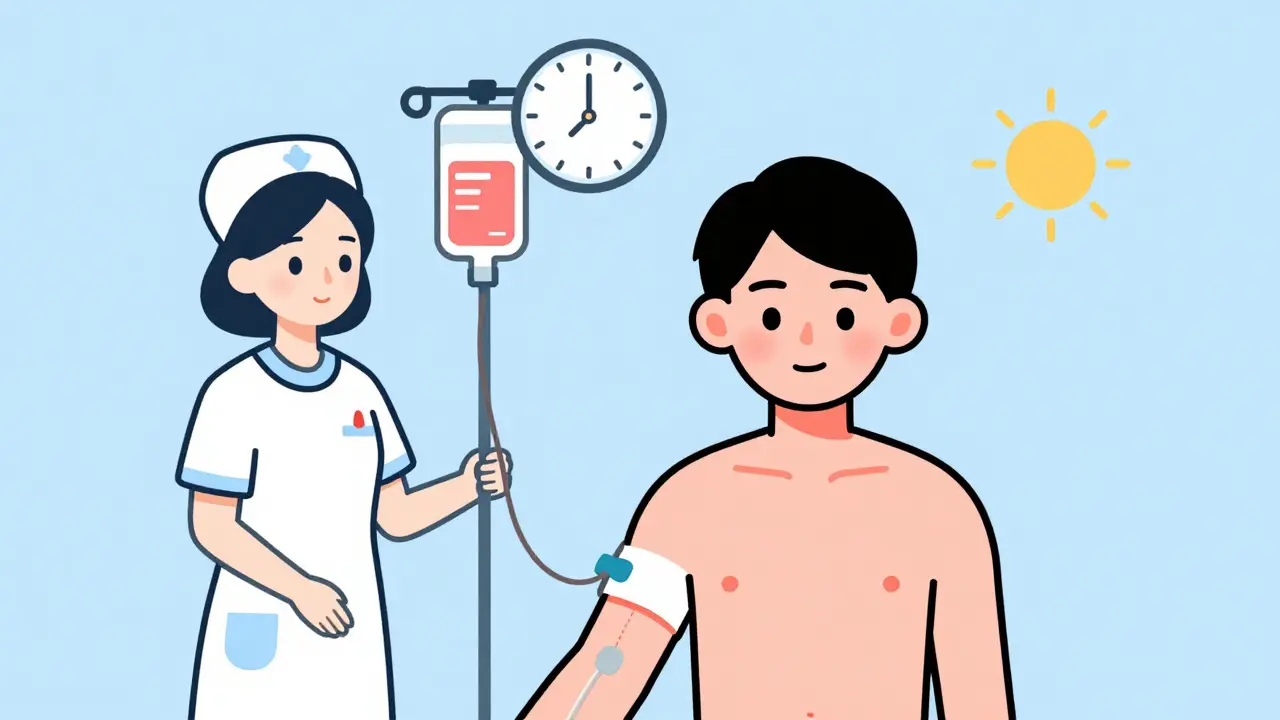
Vancomycin infusion reaction, once known as "red man syndrome," is not an allergy. It’s an anaphylactoid reaction. That means it looks like an allergic reaction-flushing, itching, rash-but it’s not caused by your immune system recognizing the drug as a threat. Instead, vancomycin directly triggers mast cells and basophils to dump histamine into your bloodstream. No prior exposure needed. No IgE antibodies involved. Just a fast infusion and a body that reacts.
This reaction happens in about 80% of people who get a 1000 mg dose of vancomycin over just one hour. That’s according to a 1988 study in The Journal of Infectious Diseases. But here’s the thing: if you slow it down to 10 mg per minute or slower, you cut that risk dramatically. Most reactions disappear entirely when the infusion takes at least 100 minutes.
What Does It Look Like?
Symptoms usually start 15 to 45 minutes after the infusion begins. You’ll feel warmth, then a red, itchy rash on your face, neck, chest, and upper back. It’s not a full-body rash-it stops around the waist. Some people get headaches, muscle spasms, or chest discomfort. In rare cases, blood pressure drops or heart rate spikes. But unlike true anaphylaxis, you won’t get swollen throat, wheezing, or trouble breathing. Those are signs of something else.
And here’s a key detail: the reaction gets less severe with each dose. That’s called tachyphylaxis. Your body gets used to it. So if you had a bad reaction on day one, you might barely notice it on day three or four. That’s why doctors don’t always stop vancomycin after one episode-they just slow it down.
Why the Name Changed
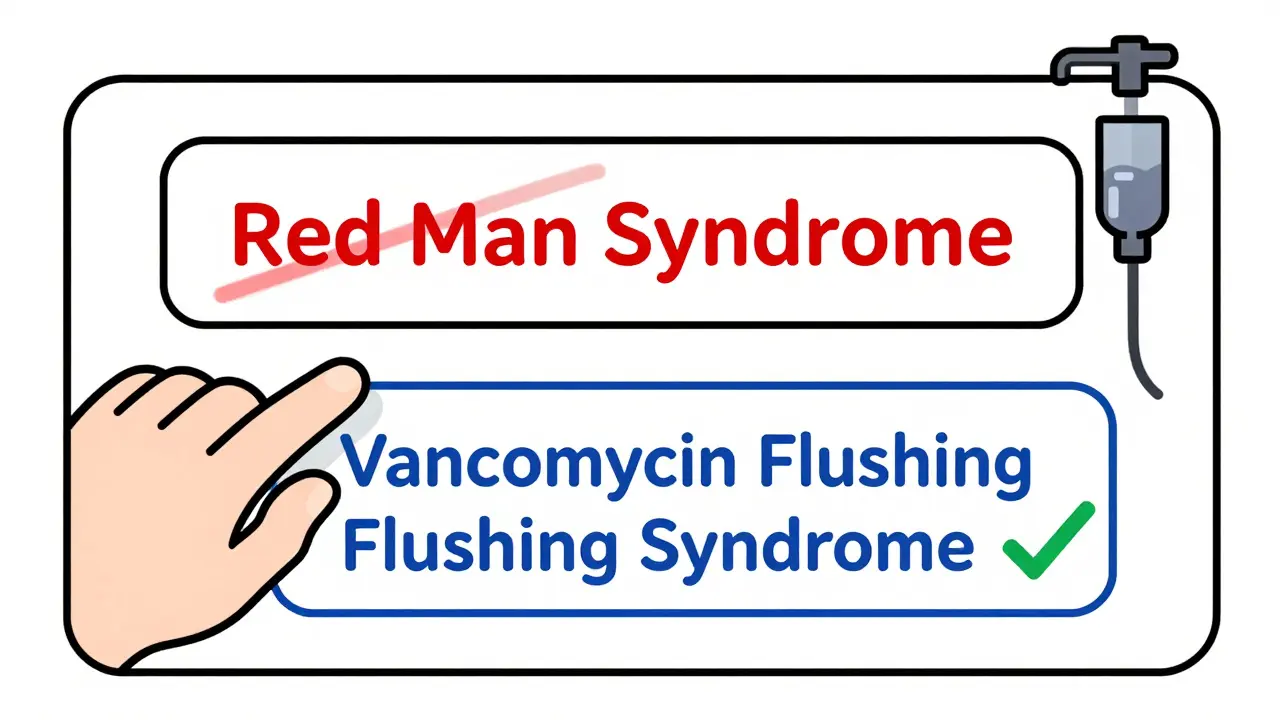
"Red man syndrome" was never accurate. It was also offensive. The term implied a racial stereotype, and it stuck in medical records for decades. In 2021, a study in Hospital Pediatrics looked at over 21,000 patient records and found that 61.6% of vancomycin "allergy" entries used the term "red man syndrome." That’s not just outdated-it’s harmful. The same study showed that after hospitals switched to "vancomycin flushing syndrome," the use of the old term dropped by 17% in just three months.
Today, major institutions like UCSF, the Infectious Diseases Society of America, and the National Library of Medicine’s StatPearls all use "vancomycin infusion reaction" or "vancomycin flushing syndrome." The American Academy of Allergy, Asthma & Immunology supports this change. Terms like "red man syndrome" reinforce bias and distract from real patient care. Language matters. And in medicine, it can save lives.
Differentiating From True Allergies
It’s easy to confuse vancomycin flushing with anaphylaxis. But they’re different. True anaphylaxis is IgE-mediated. It requires prior exposure. It can cause airway swelling, low blood pressure, and cardiac arrest. It’s rare with vancomycin-only 3% of patients labeled "allergic" to vancomycin actually had true anaphylaxis, according to UCSF’s 2022 guideline.
More common than anaphylaxis are other serious reactions like DRESS, SJS, or TEN. These are immune-mediated, delayed, and can be life-threatening. But they’re not the same as flushing syndrome. The key difference? Timing. Flushing happens during or minutes after the infusion. DRESS or SJS appear days or weeks later, with fever, blistering, and organ damage.
That’s why blanket "vancomycin allergy" labels are dangerous. If a patient is labeled "allergic," they might be given a less effective antibiotic, which can lead to treatment failure, longer hospital stays, or even death. The goal isn’t to avoid vancomycin-it’s to use it safely.
How to Prevent It
The best way to stop vancomycin flushing? Slow the drip.
- Infuse 1 gram over at least 100 minutes (that’s 10 mg per minute or slower).
- Never give it as a rapid IV push.
- Avoid giving it with other histamine-releasing drugs like opioids, muscle relaxants, or contrast dye.
Pre-medication with antihistamines like diphenhydramine (Benadryl) or ranitidine used to be routine. But now, experts say: don’t premedicate unless the patient already had a reaction. There’s no benefit for first-time users. It adds cost, side effects, and delays care.
And if the reaction happens? Stop the infusion immediately. Wait 30 minutes. Check vitals. Reassess. Most symptoms fade on their own. If they don’t-or if the patient is hypotensive-call for help. You might need fluids or vasopressors. But you don’t need to stop vancomycin forever.

What About Other Drugs?
Vancomycin isn’t alone. Other antibiotics and drugs can cause similar reactions:
- Amphotericin B triggers histamine release via complement activation.
- Rifampicin forms reactive metabolites that bind to proteins and provoke immune responses.
- Ciprofloxacin can cause flushing, especially with rapid infusion.
If a patient has had a reaction to one of these, slow the infusion of the next. The pattern is the same: speed triggers the reaction. Slow it down, and you avoid the problem.
What If You’ve Been Labeled "Allergic"?
If your chart says "vancomycin allergy," ask: "Was this ever confirmed?" Many patients are labeled based on a flushing reaction that was never properly evaluated. A true allergy requires testing-like a skin test or challenge under supervision.
For patients who need vancomycin but have a history of flushing, the solution is simple: slow the infusion. Use a pump. Monitor closely. You might even get the full benefit of the drug without any symptoms.
Don’t let an outdated label cost you the right treatment. Vancomycin saves lives. It shouldn’t be avoided just because someone didn’t know how to give it safely.
Final Thoughts
Vancomycin is one of the most important antibiotics we have. But it’s not a magic bullet. It’s a tool-and like any tool, it needs to be used correctly. Slowing the infusion isn’t just a precaution-it’s standard care. Changing the name isn’t just political correctness-it’s clinical accuracy.
Doctors, nurses, and pharmacists all have a role: slow the drip. Check the label. Educate the team. And never assume a reaction is an allergy unless it’s proven.
For patients: if you’ve ever turned red during an IV, speak up. Say: "I think it was the infusion speed." That simple phrase could save you from being labeled "allergic" for the rest of your life.
Is vancomycin flushing syndrome the same as an allergy?
No. Vancomycin flushing syndrome is not an allergy. It’s an anaphylactoid reaction caused by direct histamine release from mast cells. True allergies involve IgE antibodies and require prior exposure. Flushing can happen the first time you get vancomycin, while true allergies cannot.
Can you still take vancomycin if you had a reaction before?
Yes. Most people who have had a reaction can safely receive vancomycin again if the infusion is slowed to 10 mg per minute or slower. The reaction often becomes less severe with repeated doses. Stopping vancomycin entirely is rarely necessary unless there’s a true allergy or another serious reaction like SJS or DRESS.
Why is the term "red man syndrome" no longer used?
The term "red man syndrome" was dropped because it’s racially insensitive and medically inaccurate. It implied a stereotype and was not based on science. Modern guidelines now use "vancomycin infusion reaction" or "vancomycin flushing syndrome" to describe the actual mechanism and avoid harmful language.
Do you need to pre-medicate with antihistamines before vancomycin?
No, not for first-time users. Pre-medication with diphenhydramine or ranitidine was once routine, but studies show it doesn’t prevent reactions in people who’ve never had one. The best prevention is slowing the infusion rate. Pre-medication is only considered for patients with prior reactions who need a faster infusion.
How long does the reaction last?
Symptoms usually appear 15 to 45 minutes after starting the infusion and resolve within 30 minutes after stopping it. In rare cases, they may linger slightly longer, but they almost always go away on their own without treatment.
Can vancomycin flushing cause long-term damage?
No. Vancomycin flushing syndrome is temporary and does not cause lasting harm. It doesn’t damage organs, skin, or tissues. The redness, itching, and flushing are uncomfortable but not dangerous if managed properly. The real risk is mislabeling it as an allergy, which can lead to inappropriate antibiotic choices.
Are there alternatives to vancomycin if someone has a reaction?
Not usually. Vancomycin is often the only effective option for serious MRSA infections. If a patient has a reaction, the answer isn’t switching drugs-it’s slowing the infusion. Alternatives like daptomycin or linezolid exist but are more expensive or have different side effect profiles. Slowing the infusion is safer and more effective than switching.


Amina Aminkhuslen
March 8, 2026 AT 08:51