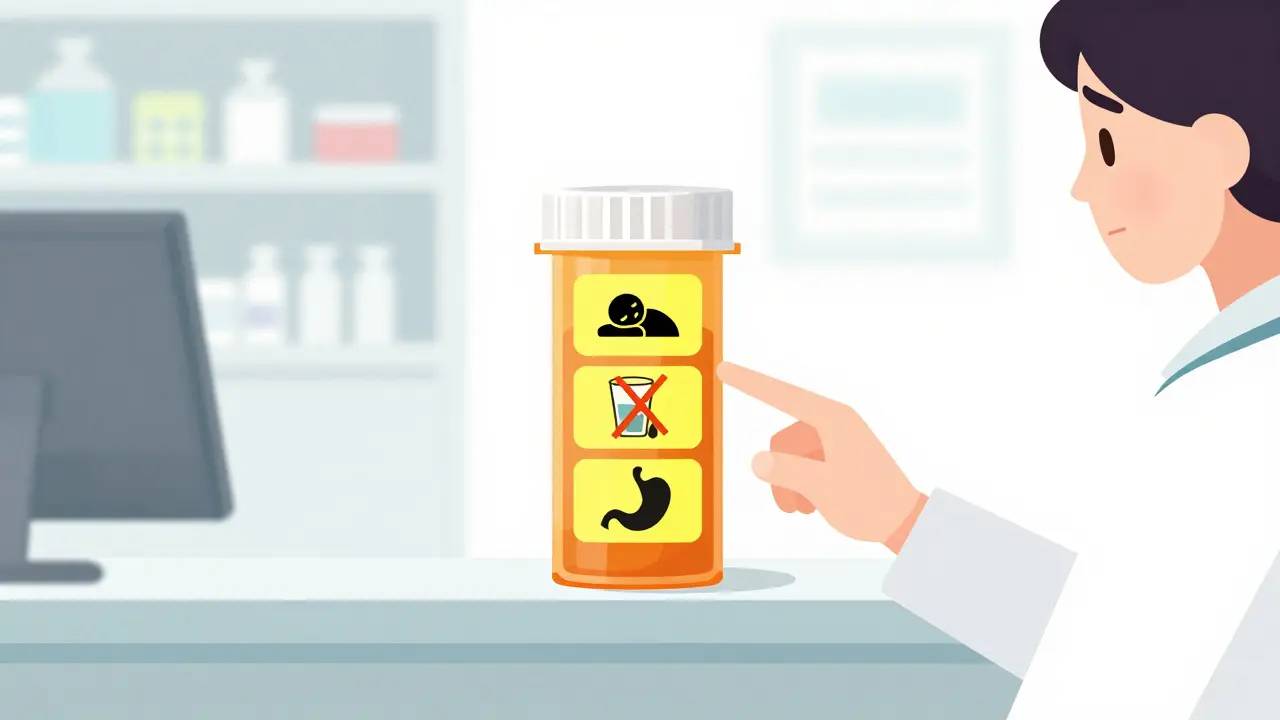
When you pick up your prescription, you might not think much about the small yellow sticker on the bottle. But that sticker could be the difference between staying safe and ending up in the hospital. These aren’t just random decorations-they’re standardized warning icons designed to tell you something critical about your medicine. And if you don’t understand them, you’re at risk.
What Do These Icons Actually Mean?
Pharmacy warning icons are visual cues that tell you how to take your medicine safely. They’re not the same as the printed instructions. Instead, they use color, symbols, and short phrases to get your attention fast. In New Zealand, these are called Cautionary and Advisory Labels (CALs), and they’re almost always yellow. You’ll see them on pills, liquids, eye drops, and inhalers. One common label says: This medicine may make you sleepy and make it dangerous to drive or operate machinery. Limit alcohol intake. That’s not just advice-it’s a safety rule. If you’re taking a sedative, antihistamine, or certain painkillers, this warning applies. Ignoring it could lead to a car crash or a fall. Another common one: Take on an empty stomach. That means no food for at least an hour before and after. Food can block absorption, making the drug useless-or worse, causing side effects. Color matters too. Yellow usually means caution. Red means danger. Blue or green often mean general advice. But here’s the problem: not everyone reads the same way. A 2019 study found that 42% of patients think red means "stop taking this," even when it’s just a reminder to take it with food. And symbols? The little picture of a glass with a drop in it might look like "take by mouth," but if it’s on an eye drop bottle, it’s actually saying "do not swallow." People have accidentally swallowed eye drops because of this confusion.Why Do These Warnings Exist?
Every year in the U.S. alone, medication errors contribute to at least 7,000 deaths. Many of those happen because patients didn’t understand their labels. The Institute for Safe Medication Practices (ISMP) started pushing for standardized icons in the 1990s. By 2005, big pharmacy chains began using them. Now, about 90% of prescription bottles in the U.S. have at least one warning sticker. The goal is simple: cut down on mistakes. A label saying Do not chew or crush, swallow whole is meant to prevent people from breaking open capsules. But here’s the twist: a study found that 57.3% of patients thought it meant "don’t swallow at all." That’s not just confusing-it’s dangerous. The same thing happened with For external use only. Written at a first-grade reading level, it was misunderstood by 90.7% of people in one test. They thought it meant "apply to skin only," not "do not ingest." These icons work best when they’re simple, consistent, and paired with a pharmacist’s explanation. Research shows that when patients get both a visual warning and a verbal explanation, their understanding improves by 63%.How Do Warning Systems Differ Around the World?
New Zealand’s system is simpler than the U.S.’s. Since 2018, the country has used one national set of CALs. That means no matter which pharmacy you go to in Wellington, Auckland, or Christchurch, the same yellow sticker means the same thing. This uniformity led to 22% better patient understanding compared to the U.S., according to a 2022 Commonwealth Fund study. In the U.S., it’s a mess. CVS uses 14 different warning labels. Walgreens uses 17. Independent pharmacies? They might use up to 23. Some use red for allergies. Others use red for "take with food." That inconsistency confuses people-even those who’ve been taking meds for years. The U.K. fixed this by standardizing just nine labels nationwide. After implementation, misinterpretation dropped from 39% to 17%. That’s a huge win. The FDA noticed. In September 2022, they proposed a national standard of 12 core warning icons. CVS and Walgreens already pledged to align with this by late 2024. Change is coming-but slowly.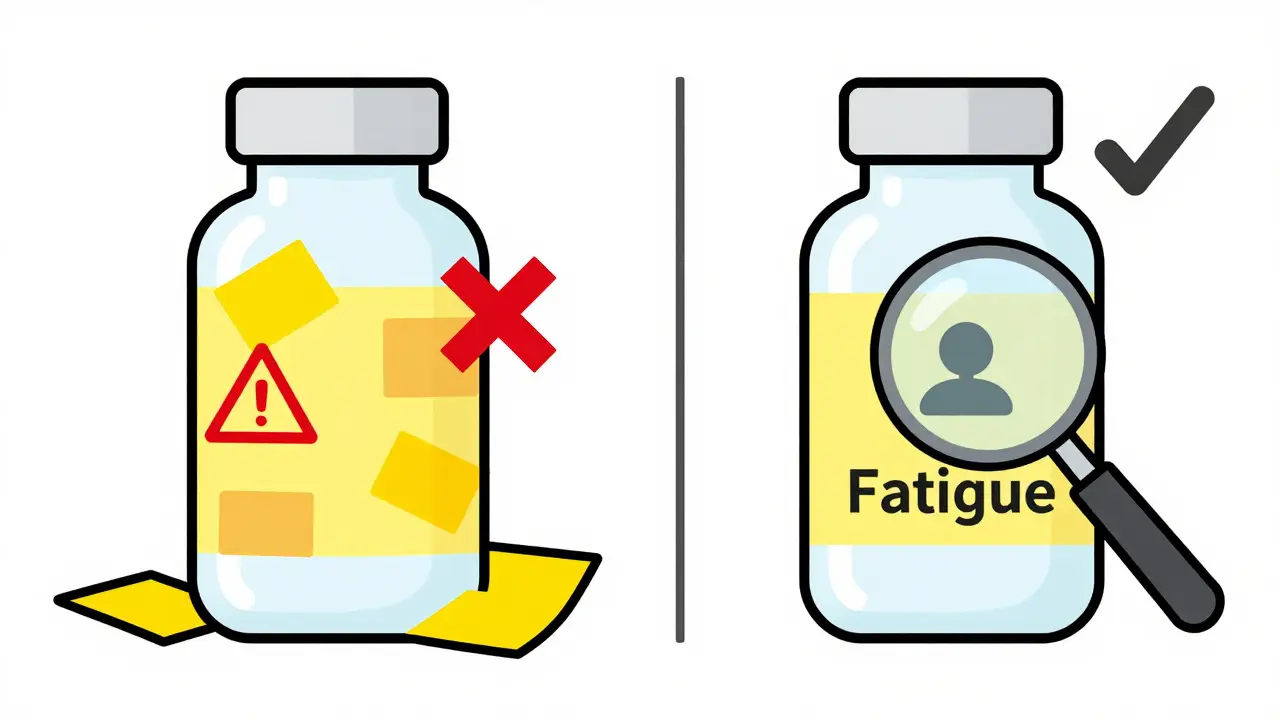
What Makes a Warning Label Fail?
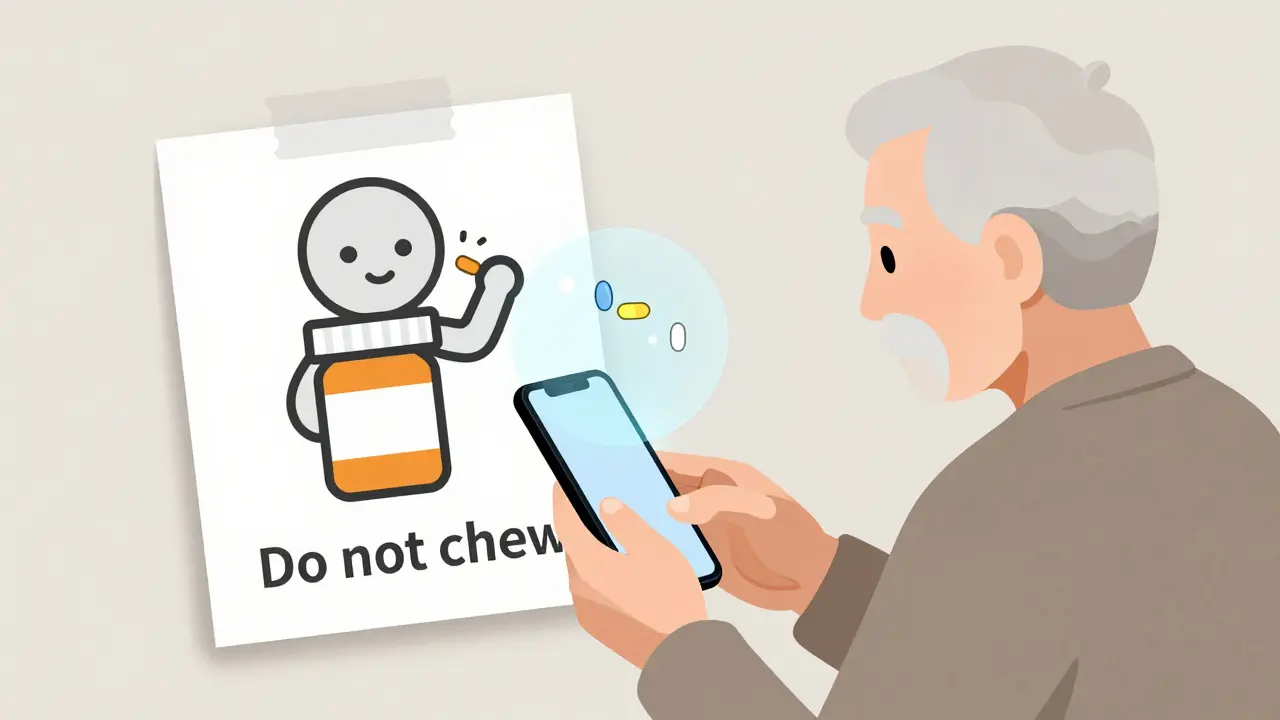
It’s not just about the design. It’s about how they’re used. Many pharmacists overload labels. A 2021 study found that 38.7% of pharmacists stick on too many warnings. If you’ve got five yellow stickers on a bottle, you stop reading them. You tune out. The most important one-like May cause dizziness-gets lost. Another problem? Text is too small. FDA guidelines say critical warnings must be at least 6-point font. But many bottles still use 5-point. For older adults or people with poor eyesight, that’s unreadable. And let’s not forget literacy. A warning like Do not use if pregnant might be clear to someone with a college degree. But to someone with limited reading skills, it’s vague. What counts as "use"? Is it one pill? A whole bottle? Then there’s the digital gap. Some pharmacies now put QR codes on labels that link to video instructions. Sounds smart, right? But 24% of seniors don’t use smartphones regularly, according to Pew Research. For them, that QR code is useless. It’s not innovation-it’s exclusion.How to Make Sure You Understand Your Labels
Don’t assume you know what a symbol means. Even if you’ve taken the same medicine before, the label might have changed. Here’s what to do:- Ask the pharmacist to explain every sticker. Don’t be shy. Say: "Can you tell me what this yellow label means?"
- Read the label out loud. If you can’t explain it simply, you probably don’t understand it.
- Check for color confusion. Is red being used for allergies or for "take with food"? Ask which it is.
- Keep a list. Write down each warning and what it means in your own words. Keep it in your wallet or phone.
- Use the ISMP’s free tool. Their "Medication Safety Self-Assessment" helps you spot risks before they happen.
What’s Next for Warning Labels?
The future is smarter. Kaiser Permanente tested augmented reality labels in 2022. Patients pointed their phone at the bottle, and a short video played showing how to take the medicine. Comprehension jumped from 58% to 89%. That’s huge. The University of Pittsburgh is testing AI-driven labels that change based on the patient. If you’re over 65, the system adds a warning about falls. If you have kidney disease, it highlights drug interactions. Early results show a 32% improvement in adherence. But technology won’t fix everything. Human interaction still matters most. Dr. Michael Cohen of ISMP says: "Standardized labels are necessary but insufficient without proper patient counseling." That’s the truth. No icon replaces a pharmacist who takes five minutes to explain.Final Thoughts: Don’t Ignore the Sticker
That little yellow label isn’t clutter. It’s a lifeline. It’s there because someone else got hurt because they didn’t know what the medicine could do. You might think you’ve got it figured out. But studies show that 52% of Americans misinterpret at least one common warning. And 41% think they understand labels they actually don’t. The system isn’t perfect. But it’s getting better. By 2026, the U.S. will likely have one national set of warning icons. Until then, don’t guess. Ask. Read. Double-check. Your safety depends on it.Why are pharmacy warning labels mostly yellow?
Yellow is used because it’s highly visible and universally recognized as a signal for caution. In New Zealand and many parts of the U.S., yellow stickers are the standard for advisory warnings like drowsiness, alcohol interaction, or food restrictions. It’s not about danger-that’s usually red-but about important reminders that require attention without causing panic. The color helps pharmacists quickly identify which warnings are critical, and patients to spot them even if they’re in a hurry.
Can I ignore a warning label if I’ve taken the medicine before without problems?
No. Even if you’ve taken the same medication before, your body, health status, or other drugs you’re taking may have changed. A warning like "may cause dizziness" might not have mattered when you were 30 and healthy. But at 65, with high blood pressure and a new heart medication, that same warning could mean a fall. Labels are updated based on new research, not just past experience. Always check each time you refill.
What should I do if I don’t understand a warning symbol?
Never guess. Ask the pharmacist directly. Show them the label and say: "I’m not sure what this means." Most pharmacies have printed guides showing what each icon stands for. If you’re still unsure, ask them to write it down in plain language. You can also call the drug manufacturer’s helpline-the contact number is usually on the box or bottle.
Are digital warnings (like QR codes) replacing paper labels?
They’re supplementing them, not replacing them. QR codes can link to videos or audio instructions, which help people who struggle with reading. But they’re not a substitute for physical labels. Many older adults, low-income patients, and those without smartphones can’t use them. The FDA and pharmacy groups agree: physical warnings must remain clear, readable, and accessible to everyone. Digital tools are helpful extras, not the main safety system.
Why do some pharmacies have more warning labels than others?
Because there’s no national standard in the U.S. yet. CVS, Walgreens, and independent pharmacies each developed their own systems over time. Some use extra labels to cover every possible risk, even if it’s rare. This leads to "label fatigue"-when patients see too many stickers and stop reading them. That’s why the FDA is pushing for a uniform set of 12 core warnings. By 2026, most pharmacies will use the same icons, reducing confusion.


Stacey Smith
December 20, 2025 AT 20:48