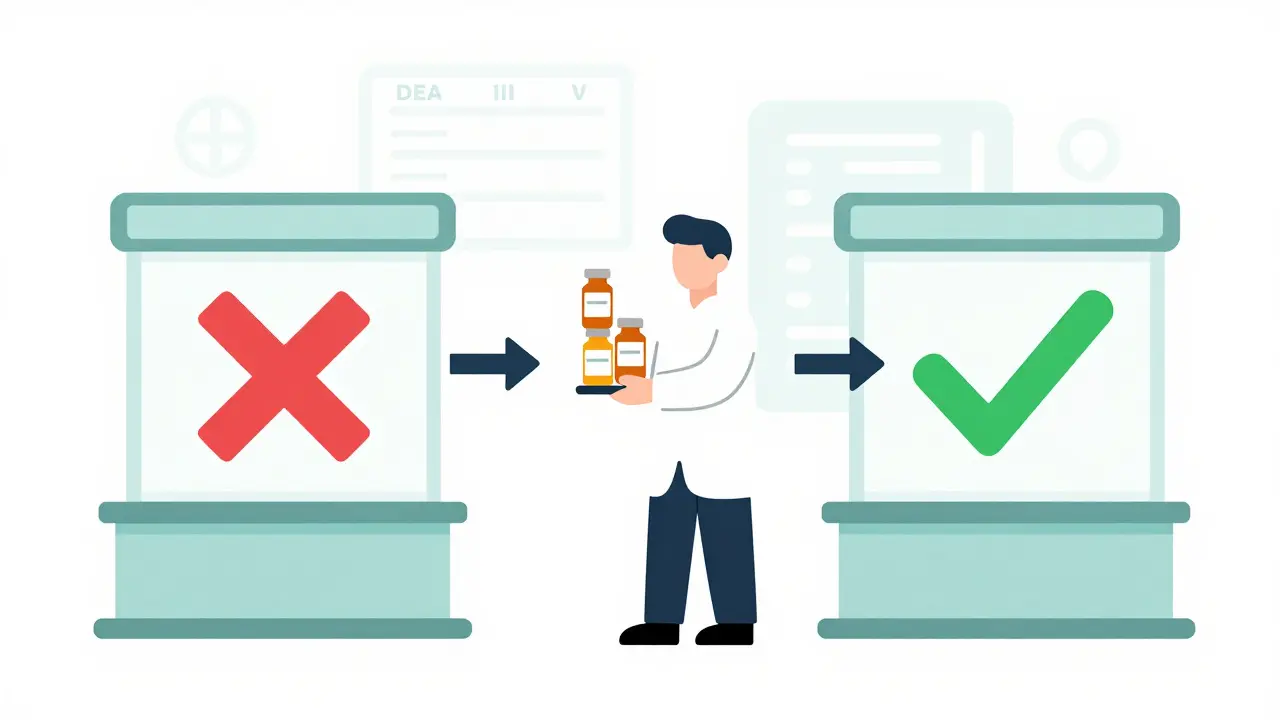
Changing pharmacies shouldn’t be a hassle-but too often, it is. If you’ve ever waited days for a prescription to transfer, only to be told it can’t be done, you know how frustrating it can be. The problem isn’t usually the pharmacy. It’s usually what information you provide-or don’t provide. Whether you’re moving, switching to a cheaper option, or just tired of long lines, knowing exactly what to give the new pharmacy can save you time, stress, and even a trip back to your doctor.
Know Your Medication’s Schedule
Not all prescriptions are treated the same. The DEA classifies medications into five schedules based on their potential for abuse and medical use. This matters because how you transfer them depends entirely on the schedule.For example, Schedule II drugs-like oxycodone, Adderall, or fentanyl-cannot be transferred at all. If you need to switch pharmacies and you’re on one of these, you must get a new prescription from your doctor. No exceptions. No workarounds. The DEA made this rule clear in 2023, and it hasn’t changed.
But here’s where it gets easier: Schedule III and IV medications-think hydrocodone (with acetaminophen), tramadol, or Xanax-can be transferred one time only. That’s it. Once it’s moved to your new pharmacy, you can’t move it again. Even if you switch pharmacies again next month, that same prescription is locked in place. You’ll need a new prescription from your doctor for any further transfers.
Schedule V drugs, like cough syrups with low-dose codeine, follow the same one-time rule. And for everything else-blood pressure pills, antibiotics, cholesterol meds, thyroid medicine-there are no limits. You can transfer these as many times as you want, as long as refills remain.
What Information to Give the New Pharmacy
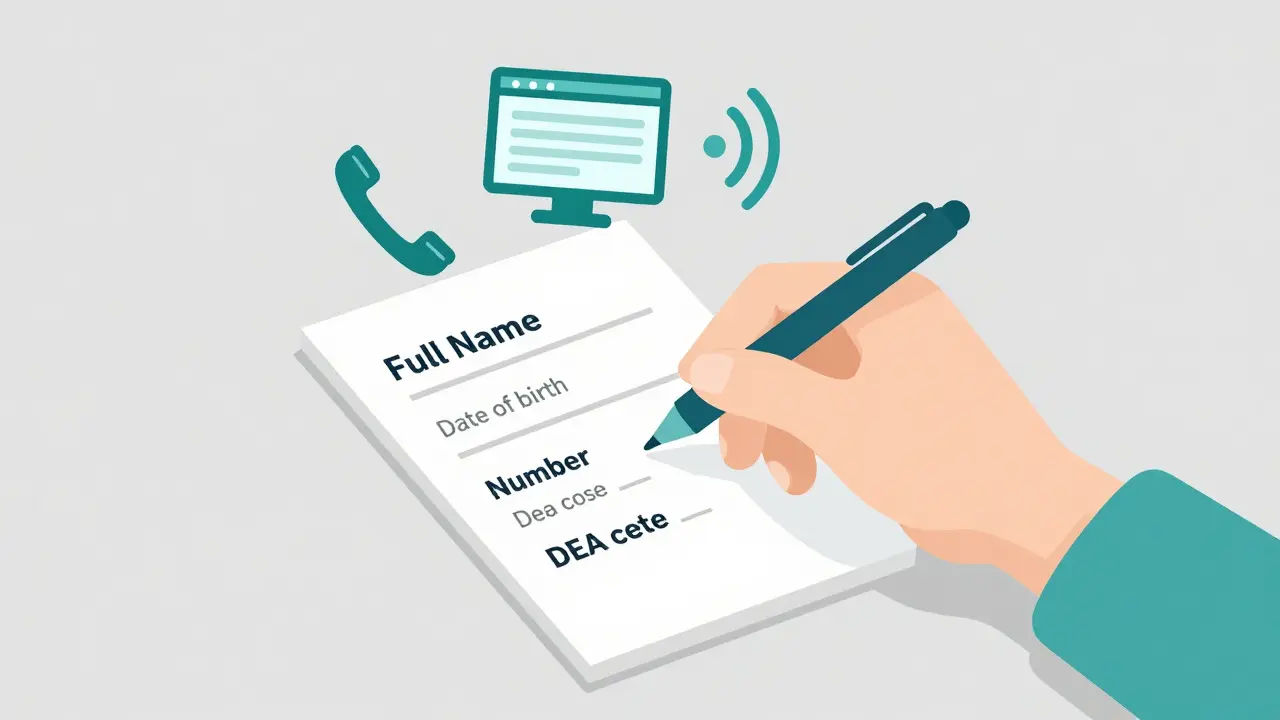
The new pharmacy needs more than just your name and the drug’s name. They need enough detail to match your prescription exactly-and legally. Here’s what you must provide:- Your full legal name (as it appears on your ID)
- Your date of birth
- Your current physical address
- The name of the medication (brand or generic)
- The dosage (e.g., 10 mg, 500 mg)
- The prescriber’s name and phone number
- The pharmacy name and location where it was originally filled
- The prescription number (usually found on the label)
- The number of refills remaining
For controlled substances (Schedule III-V), they also need the prescriber’s DEA number and the original pharmacy’s DEA number. These are long, alphanumeric codes that appear on the prescription label. If you don’t have them, ask your old pharmacy for them. Don’t assume the new one can find them on their own.
Pro tip: Write this all down before you call. Don’t rely on memory. If you’re missing one piece-like the prescription number or the prescriber’s phone number-the transfer can stall for days.
How the Transfer Actually Works
Many people think they just call the new pharmacy and say, “I want to transfer my prescriptions.” That’s not enough. The new pharmacy has to contact the old one directly. And here’s the catch: the transfer must happen electronically for controlled substances.Since August 2023, the DEA requires that electronic prescriptions for controlled substances be transferred only through secure, direct pharmacy-to-pharmacy systems. No faxes. No emails. No screenshots. No reading the label aloud. The data has to move digitally, unaltered, between two licensed pharmacists.
For non-controlled prescriptions, fax or phone transfers are still allowed-but electronic is faster. Most major chains like CVS, Walgreens, and Rite Aid use automated systems that complete transfers in 24-48 hours. Independent pharmacies? Sometimes it takes longer. Rural pharmacies with older software may need extra time to update their systems.
Once the transfer is complete, the old pharmacy must mark the original prescription as “VOID” in their system. If they forget, your new pharmacy might refuse the transfer. That’s why it’s smart to follow up: “Did you get the transfer from [Old Pharmacy]?”
What Can Go Wrong (And How to Fix It)
You’ve done everything right-but the transfer still won’t go through. Here’s why, and what to do:- No refills left: You can’t transfer a prescription that’s out of refills. You need a new one from your doctor.
- Wrong pharmacy info: Typos in the old pharmacy’s name or address? That’s a common cause of delays. Double-check the spelling.
- State laws block it: Some states have stricter rules than the DEA. For example, California and New York may require additional documentation for controlled substances. Ask your new pharmacy if your state has special rules.
- Transfer already used: If you transferred this prescription before, even to a different pharmacy, it’s locked. You need a new prescription.
- Pharmacy refuses without reason: Under federal law, pharmacies must provide a written explanation if they deny a transfer. Ask for it. If they refuse, contact your state pharmacy board.
According to a 2023 Consumer Reports survey, 68% of people who tried to transfer prescriptions ran into at least one problem. The biggest issues? Controlled substance rules (42%) and missing info (31%). Don’t be one of them.
What to Do If You’re Switching Multiple Prescriptions
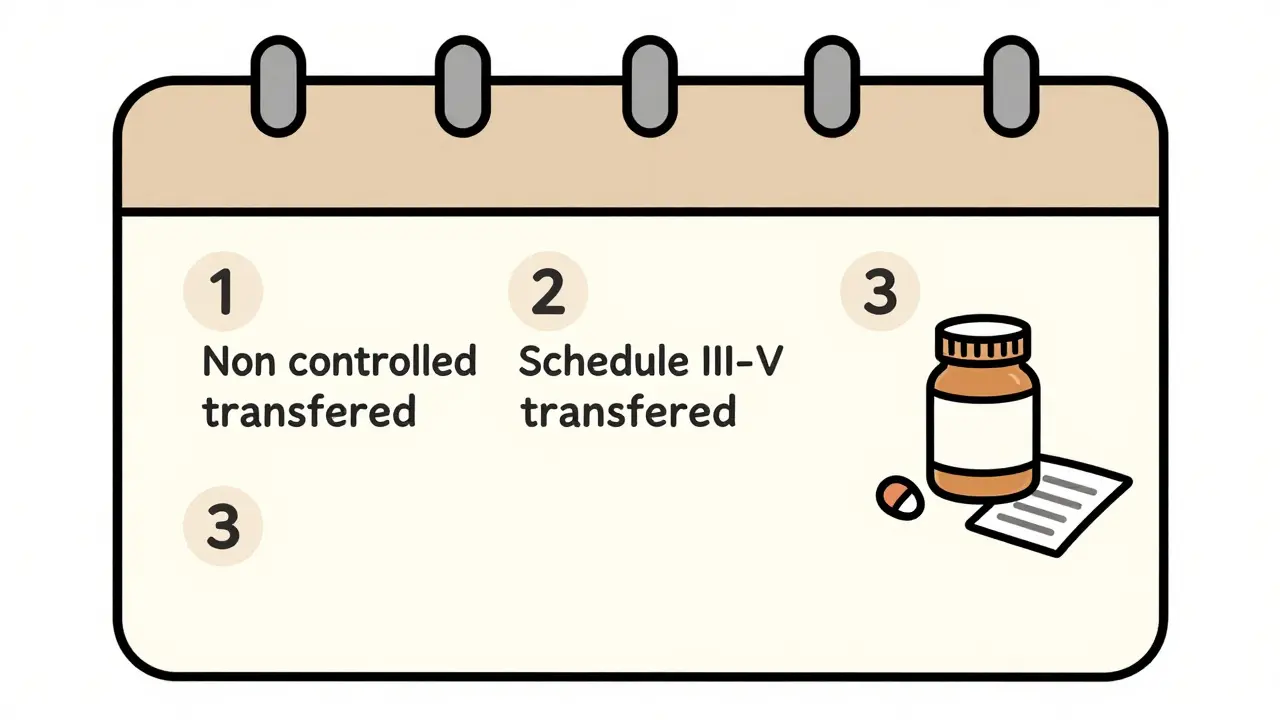
If you’re on five or six medications, don’t try to transfer them all at once. Do them one at a time. Start with your non-controlled meds-they’re easiest. Then move to your Schedule III-V drugs. Save Schedule II for last, since you’ll need a new prescription anyway.Plan ahead. Give yourself at least 3-5 business days. If you’re running low on medication, ask your old pharmacy for a one-time emergency refill. Most will give you a 7-day supply if you’re switching.
Keep a list of all your prescriptions, dosages, and refill counts. Update it every time you get a new bottle. That way, when you switch, you’re not guessing.
What’s Changing Soon
The DEA’s 2023 rule was a big step forward. Before, if you changed pharmacies, you had to go back to your doctor to cancel the old prescription and get a new one. Now, you don’t. But the system is still limited.Industry experts expect the DEA to allow multiple transfers for controlled substances within the next 2-3 years. They’re collecting data now to see how the one-time rule impacts misuse, access, and patient safety. For now, though, you’re stuck with one shot.
Also, more pharmacies are going digital. As of Q3 2023, 92% of controlled substance prescriptions in the U.S. are sent electronically. That means fewer errors, faster transfers, and better tracking. But if your pharmacy still uses paper, you’ll need to be more involved in the process.
Final Tips to Make It Smooth
- Call the new pharmacy before you go. Ask if they accept electronic transfers and if they’ve had issues with your old pharmacy’s system.
- Bring your medication bottles with you. The labels have all the info they need.
- Don’t wait until your last pill is gone. Start the transfer when you have 5-7 days left.
- Keep a copy of your prescription list. Use your phone’s notes app or a printed sheet.
- If you’re transferring across state lines, expect delays. Some states don’t recognize transfers from others.
Switching pharmacies doesn’t have to be a nightmare. With the right info, the right timing, and a little patience, you can get your meds without missing a dose. Just remember: controlled substances have rules. Non-controlled ones don’t. Know the difference. And always ask questions.


sagar patel
December 24, 2025 AT 17:48