Imagine spending years developing a life-saving drug, only to have the FDA issue a warning letter because you couldn't prove the medicine stays potent on a pharmacy shelf in Florida's humidity. That is exactly why stability testing exists. It isn't just a bureaucratic hurdle; it is the only way to ensure that a pill manufactured in January is just as safe and effective in December.
At its core, stability testing requirements are designed to reveal how a drug substance or product changes over time. Whether it's a simple tablet or a complex monoclonal antibody, environmental stressors like heat, moisture, and light can trigger chemical degradation. By simulating these conditions, manufacturers can set a reliable shelf life and define exactly how a product must be stored to prevent it from becoming useless or, worse, toxic.
The Global Gold Standard: ICH Q1A(R2)
If you're working in pharma, the ICH Q1A(R2) is your bible. The International Council for Harmonisation (ICH) created these guidelines to align the US, EU, and Japanese markets, so companies don't have to run three different sets of tests for the same drug. This harmonization is a massive win for efficiency, reportedly saving companies around $1.2 million per product in testing costs.
Most regulatory bodies, including the FDA and the EMA, follow these standards. They focus on three main types of studies: long-term, intermediate, and accelerated. Each uses a specific combination of temperature and humidity to stress the product.
Breaking Down Temperature and Humidity Conditions
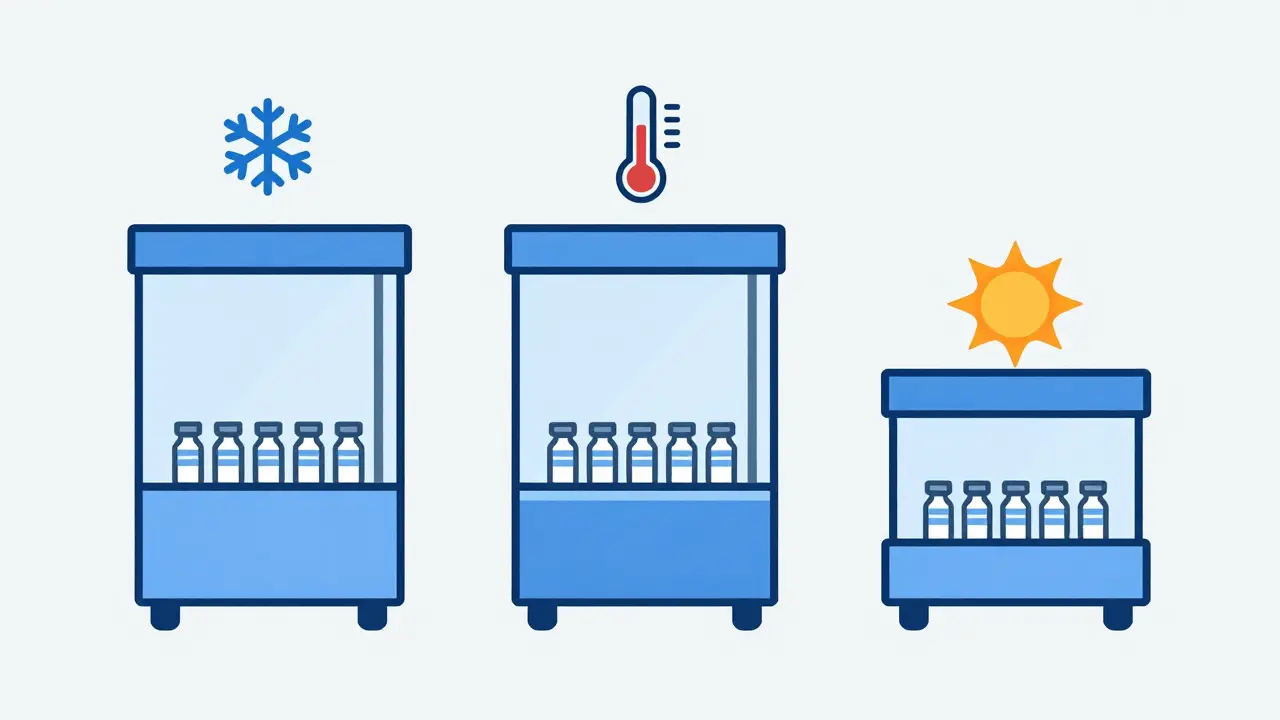
Not all drugs are stored the same way. A room-temperature tablet has very different requirements than a refrigerated vaccine. Here is how the conditions are typically broken down.
| Study Type | Temperature | Relative Humidity (RH) | Duration |
|---|---|---|---|
| Long-Term (General) | 25°C ± 2°C / 30°C ± 2°C | 60% RH ± 5% / 65% RH ± 5% | 12+ Months |
| Intermediate | 30°C ± 2°C | 65% RH ± 5% | 6 Months |
| Accelerated | 40°C ± 2°C | 75% RH ± 5% | 6 Months |
| Refrigerated (Long-Term) | 5°C ± 3°C | N/A | 12 Months |
| Refrigerated (Accelerated) | 25°C ± 2°C | 60% RH ± 5% | 6 Months |
The accelerated condition (40°C/75% RH) is essentially a "stress test." It's meant to mimic the worst-case scenarios, like a shipping container sitting on a hot tarmac. If a drug can survive six months here, it often correlates to about 24 months of real-time stability at room temperature for most small-molecule drugs.
Navigating the Five Global Climatic Zones
A drug sold only in Norway doesn't need the same testing as one sold in Brazil. The ICH divides the world into climatic zones to ensure the testing matches the environment where the patient actually lives. If you're targeting global markets, you have to account for these variations:
- Zone I (Temperate): Focuses on cooler climates (e.g., 21°C/45% RH).
- Zone II (Mediterranean/Subtropical): The standard for many US and EU markets (25°C/60% RH).
- Zone III (Hot-Dry): Tailored for arid regions (30°C/35% RH).
- Zone IVa (Hot-Humid): Typical for tropical regions (30°C/65% RH).
- Zone IVb (Hot/Higher Humidity): The most extreme humidity requirements (30°C/75% RH).
Ignoring these zones is a recipe for disaster. For instance, Merck once used intermediate testing at 30°C/65% RH to find a polymorphic transition in Keytruda® that would have caused bioavailability issues in tropical markets. Without that specific condition, the problem would have remained hidden until the drug reached the patient.
Timing Your Tests: The Stability Schedule
You can't just put a drug in a chamber and check it after a year. You need a rigorous sampling schedule to see how the drug degrades. The standard timeline usually follows these intervals: 0, 3, 6, 9, 12, 18, 24, and 36 months.
Early on, testing is more frequent. If you expect the drug to be unstable, you might add more checks in the first six months. The goal is to create a degradation curve. If the assay result drops-say, from 100% to 96%-you need to determine if that's a statistical fluke or a trend. Interestingly, some analysts have reported that even a tiny drop, like a 4.8% deviation, can lead to regulatory rejection if it crosses a predefined specification limit, regardless of whether it's statistically significant.
Common Pitfalls and Real-World Failures
On paper, stability testing seems simple. In a lab, it's a nightmare of precision. Many professionals report that temperature excursions are common; nearly 80% of stability experts have dealt with a chamber drifting more than ±2°C, which can invalidate an entire year of data.
Then there's the "significant change" problem. The ICH guidelines don't give a hard number for what constitutes a "significant change" during accelerated testing. This creates a gray area where manufacturers and regulators often clash. If a drug shows a slight change at 40°C, you're forced to conduct intermediate testing at 30°C to prove the drug is still stable under less extreme conditions.
We also see failures with complex biologics. Standard ICH protocols were built for small-molecule pills, not lipid nanoparticles or mRNA vaccines. These complex structures can be ruined by a single freeze-thaw cycle, something that standard constant-temperature chambers don't even test for. This has led to high-profile stability failures and recalls from companies like Amgen and Roche regarding monoclonal antibodies.
The Future: Moving Beyond the Chamber
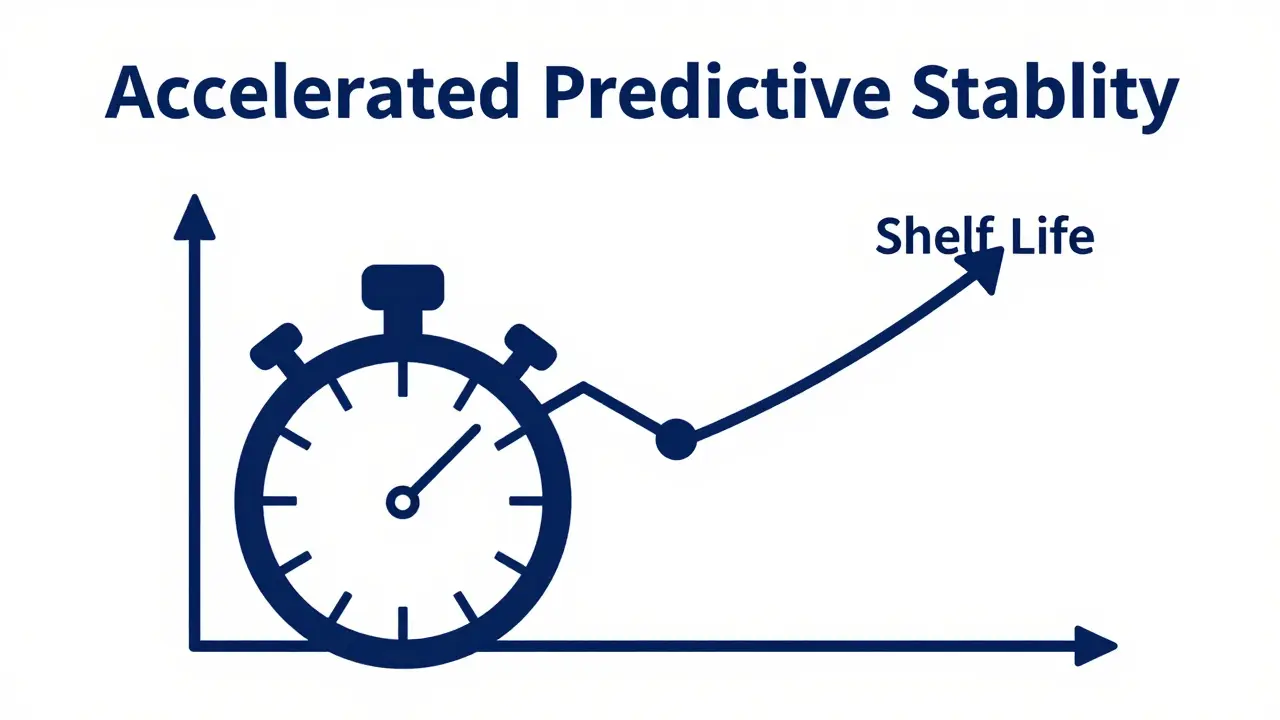
The industry is tired of waiting 24 months for a study to finish. We're seeing a shift toward Accelerated Predictive Stability (APS). Instead of just 40°C, APS uses extreme temperatures (50-80°C) to force degradation quickly, then uses mathematical modeling to predict the real-time shelf life. About 74% of the top 20 pharma companies are already using this to shave 9 to 12 months off their time-to-market.
Additionally, the FDA is piloting the use of Process Analytical Technology (PAT) for continuous manufacturing. The dream is "real-time release testing," where the stability is guaranteed by the manufacturing process itself, potentially making some traditional long-term studies redundant.
What happens if a drug fails the accelerated stability test?
If a "significant change" occurs at 40°C/75% RH, the manufacturer must conduct intermediate testing at 30°C/65% RH. If the drug also fails at the intermediate level, the company may need to change the packaging (e.g., using more moisture-resistant blisters) or shorten the proposed shelf life.
How much data is required for an initial FDA submission?
Generally, the FDA requires a minimum of 12 months of long-term stability data at the time of submission. However, the EMA may allow 6 months of data depending on the submission option chosen, which can create a timing gap for companies seeking global approval.
Why is humidity so important in stability testing?
Many drugs are hygroscopic, meaning they absorb moisture from the air. This can lead to chemical hydrolysis (breaking down the drug molecule) or physical changes like tablet softening. In fact, about 62% of stability failures in solid oral doses are caused by humidity cycling rather than constant heat.
What are the requirements for refrigerated product testing?
Refrigerated products are stored at 5°C ± 3°C for long-term studies (12 months). Accelerated testing is typically done at 25°C ± 2°C/60% RH for 6 months, rather than the 40°C used for room-temperature products, to avoid completely destroying the temperature-sensitive protein or molecule.
Can a company use a CRO for stability testing?
Yes, and it's becoming very common. About 65% of smaller biotech companies outsource to Contract Research Organizations (CROs) like WuXi AppTec or Charles River Laboratories because the cost of qualifying and maintaining ISO-standard chambers is prohibitively high.