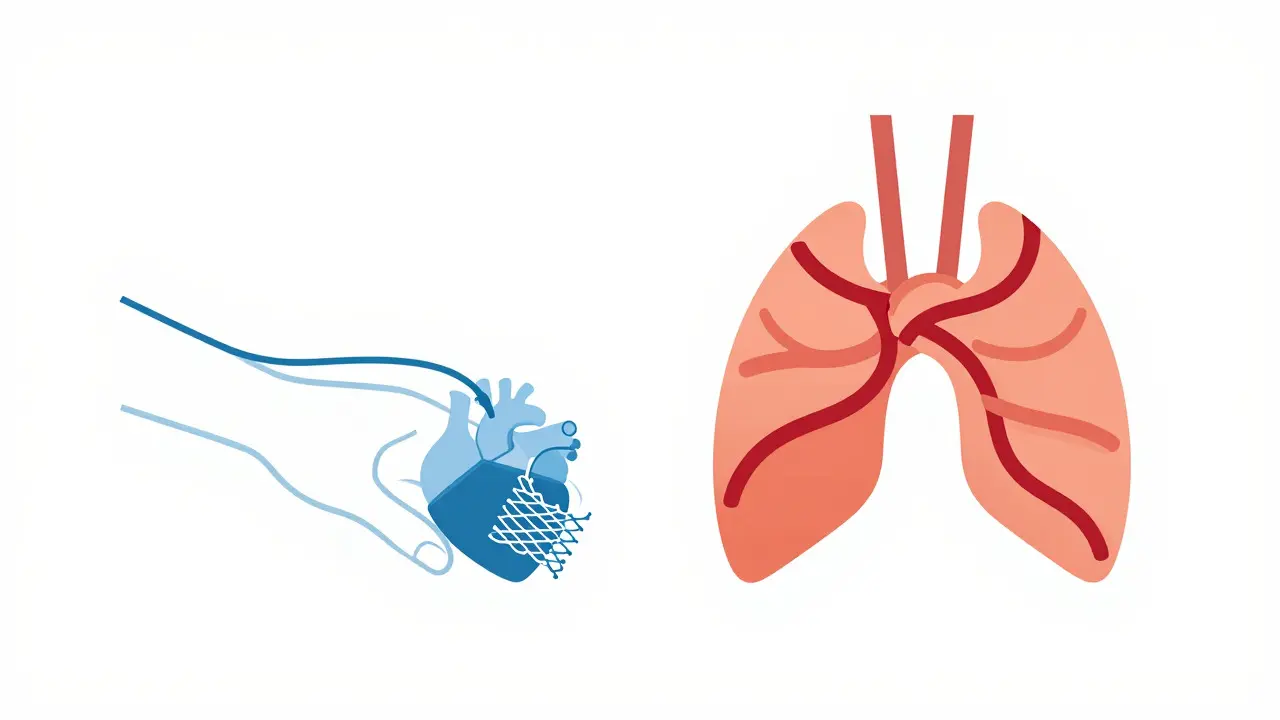
Imagine you're told your heart arteries are blocked. The doctor offers two paths: a quick catheter procedure or open-heart surgery. It’s a heavy decision, and the stakes feel high. But here’s the truth: there is no single “better” option. The right choice depends entirely on your anatomy, your health history, and how complex the blockages are.
Percutaneous Coronary Intervention (PCI) and Coronary Artery Bypass Grafting (CABG) are the two main ways doctors treat significant coronary artery disease. While both aim to restore blood flow and relieve chest pain, they work very differently. One uses a stent to prop an artery open; the other builds a new highway around the blockage. Choosing between them isn’t just about preference-it’s about long-term survival and quality of life.
The Core Difference: Stents vs. Bypasses
PCI is a minimally invasive procedure where a cardiologist threads a thin tube through an artery in your wrist or groin to reach the heart. Once at the blockage, they inflate a balloon to widen the artery and usually place a metal mesh tube called a stent to keep it open. Most modern stents are drug-eluting, meaning they slowly release medication to prevent scar tissue from forming inside.
In contrast, CABG is an open-heart surgical procedure where a surgeon takes a healthy blood vessel from another part of your body and attaches it to your coronary arteries, creating a bypass around the blocked sections. The most common graft is the left internal mammary artery (LIMA), which is connected to the left anterior descending (LAD) artery. This arterial connection is known for lasting decades.
Think of it this way: PCI is like unclogging a drain with a wire. CABG is like installing a new pipe that goes around the clog entirely. One fixes the spot; the other reroutes the traffic.
Key Metrics: How Long Do They Last?
Durability is often the deciding factor for patients worried about future procedures. Data from major clinical trials gives us a clear picture of longevity.
| Feature | PCI (Stenting) | CABG (Bypass Surgery) |
|---|---|---|
| Hospital Stay | 1-2 days | 5-7 days |
| Recovery Time | 1-2 weeks | 6-8 weeks |
| Repeat Revascularization Rate (5 yrs) | ~20% | ~10% |
| Graft/Stent Patency (10 yrs) | Varies by lesion type | 85-90% (Arterial grafts) |
| Stroke Risk (30 days) | Lower (~0.6%) | Higher (~1.2%) |
According to the PREVENT IV trial, arterial grafts used in CABG maintain patency rates of 85-90% over ten years. Venous grafts, taken from the leg, have lower patency rates of 60-70%. For PCI, drug-eluting stents have significantly improved outcomes compared to older bare-metal stents, reducing the need for repeat procedures to roughly 5-10% at five years for simple lesions. However, if you have complex blockages, that number climbs.
Who Should Choose Which Procedure?
This is where the "Heart Team" approach comes in. Guidelines from the American College of Cardiology (ACC) and American Heart Association (AHA) recommend that decisions be made by a group including interventional cardiologists and cardiac surgeons. They look at specific factors:
- Diabetes: If you have diabetes and multivessel disease, CABG is generally preferred. The FREEDOM trial showed that diabetic patients had a 5-year mortality rate of 16.4% with PCI versus 10.0% with CABG. That’s a significant survival advantage for surgery.
- Complexity of Blockages (SYNTAX Score): Doctors use a scoring system called the SYNTAX score to measure how tangled and severe the blockages are. A score below 22 usually favors PCI. A score above 32 strongly favors CABG. Scores in between require careful individual assessment.
- Left Main Disease: If the main trunk of the left coronary artery is blocked, CABG has traditionally been the gold standard. Recent trials like EXCEL suggest PCI might be comparable for less complex left main cases, but CABG still holds a slight edge in long-term durability.
- Surgical Risk: If you are elderly or have other conditions that make open-heart surgery risky, PCI is often the safer bet because it carries a lower immediate procedural risk.

What to Expect: Recovery and Quality of Life
The trade-off is time. PCI patients typically return to normal activities within a week or two. In one registry analysis, 87% of PCI patients were back at work within two weeks. CABG patients face a longer road. Sternal healing takes six to eight weeks, and many report chest tightness or fatigue during this period. Only 32% of CABG patients returned to work within two weeks, though by six months, nearly everyone had recovered fully.
However, the long-term comfort level differs. The ROSETTA trial found that at one year, CABG patients reported better angina relief scores than PCI patients. About 92% of CABG patients reported complete symptom relief, compared to 85% of PCI patients. Some PCI patients experience recurrent angina because not all diseased segments may have been treated, or because the stented area narrows again over time.
Cognitive concerns, often colloquially called "pump head," are a worry for some CABG patients. Studies show that while up to 18% may report memory issues at six weeks, this drops to 5% by one year. For most, these effects are temporary.
Cost and Insurance Considerations
Money matters. In the United States, Medicare reimbursement averages $12,500 per PCI procedure, whereas CABG averages $35,000. This price difference reflects the complexity and resource intensity of surgery. However, insurance coverage can vary. Many insurers now require prior authorization for CABG in lower-risk patients, arguing that PCI should be tried first unless specific criteria are met. Always check with your provider early in the process to understand what is covered under your plan.

Future Trends and Hybrid Approaches
Medicine is evolving. We are seeing more "hybrid" approaches where surgeons perform minimally invasive robotic CABG for the most critical artery (the LAD) while cardiologists use PCI for the others. This combines the durability of the arterial graft with the quick recovery of the catheter-based intervention. Additionally, the push toward "complete revascularization"-treating all significant blockages rather than just the culprit one-is becoming standard practice, improving long-term outcomes regardless of the method chosen.
As technology advances, we may see bioresorbable scaffolds that disappear after doing their job, and even more precise imaging tools that help predict exactly who will benefit most from which procedure. For now, the data is clear: there is no one-size-fits-all answer. Your anatomy dictates the best path.
Frequently Asked Questions
Is PCI safer than CABG?
PCI has a lower immediate risk of stroke and requires a shorter hospital stay. However, CABG has a lower long-term risk of needing repeat procedures and offers a survival benefit for patients with diabetes or complex three-vessel disease. "Safer" depends on whether you are looking at the next 30 days or the next 10 years.
How long does it take to recover from a heart bypass?
Most patients stay in the hospital for 5 to 7 days. Full recovery, including returning to heavy lifting and strenuous exercise, typically takes 6 to 8 weeks. Light walking is encouraged almost immediately after discharge to aid circulation.
Can I have both PCI and CABG?
Yes. Sometimes a patient undergoes PCI for a sudden blockage causing a heart attack, and later requires CABG for remaining chronic blockages. Conversely, hybrid procedures combine both techniques in a single treatment plan to address different parts of the coronary system optimally.
What is the SYNTAX score?
The SYNTAX score is a tool doctors use to grade the complexity of coronary artery disease based on angiogram images. It counts the number of blockages, their location, and how tortuous the vessels are. A higher score indicates more complex disease, which generally makes CABG a better option than PCI.
Does diabetes change the recommendation?
Yes, significantly. For patients with diabetes and multivessel coronary disease, guidelines strongly recommend CABG over PCI. Clinical trials have consistently shown that diabetic patients survive longer and have fewer heart attacks when treated with bypass surgery rather than stents.