When you’re on Medicaid, getting your prescription meds shouldn’t feel like a maze. But for many, it is. Every state runs its own version of Medicaid, and that means your drug coverage can look totally different depending on where you live. In 2026, Medicaid still covers prescription medications for about 85 million low-income Americans-but the rules, costs, and restrictions vary wildly. So what’s actually included? Here’s the real breakdown, no jargon, no fluff.
Medicaid Must Cover Outpatient Prescriptions-But States Decide Which Ones
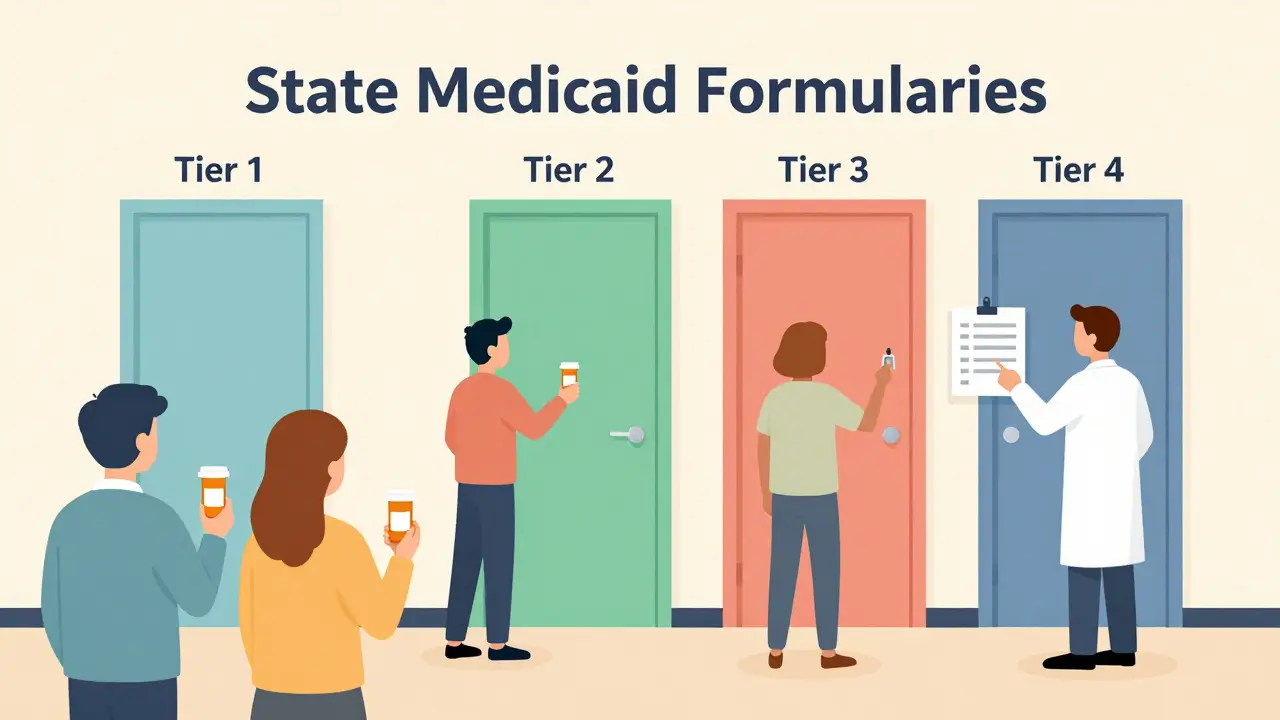
Federal law says Medicaid doesn’t have to pay for prescription drugs. Sounds wild, right? But here’s the twist: every single state, plus D.C., chooses to cover them anyway. Why? Because without drug coverage, people skip doses, end up in the ER, or get sicker. It’s cheaper in the long run to pay for pills than hospital stays. But here’s where it gets messy: each state builds its own list of approved drugs, called a Preferred Drug List (PDL). Think of it like a menu. Some drugs are on the menu (preferred), others are off (non-preferred). If your doctor prescribes something off the menu, you might have to jump through hoops just to get it.Tiered Formularies: How Much You Pay Depends on the Drug
Most states use a tier system to split drugs into cost groups:- Tier 1: Generic drugs. These are the cheapest. Copays are usually under $5.
- Tier 2: Brand-name drugs that have generic equivalents. Copays are higher-often $10-$20.
- Tier 3: Brand-name drugs with no generic. These cost more-sometimes $30-$50.
- Tier 4: Specialty drugs. These are for serious conditions like cancer, MS, or rheumatoid arthritis. Copays can hit $100+.
Step Therapy and Prior Authorization: The Hidden Roadblocks
Even if a drug is on the list, you might not get it right away. Step therapy (also called “trial and failure”) means you have to try cheaper drugs first. If those don’t work, you can request the one your doctor picked. In 2025, 38 states required you to fail two preferred drugs before covering a non-preferred one. North Carolina? Same rule. If you’re on an SSRI for depression and it’s not working, you might have to try two others before they’ll cover Wellbutrin XL. That can take weeks. Prior authorization is another hurdle. Your doctor has to fill out paperwork proving you need the drug. Sometimes it’s just a form. Other times, they need lab results, doctor notes, or proof you tried other options. If the paperwork is incomplete? Your claim gets denied. And appeals? They can take up to 14.5 business days.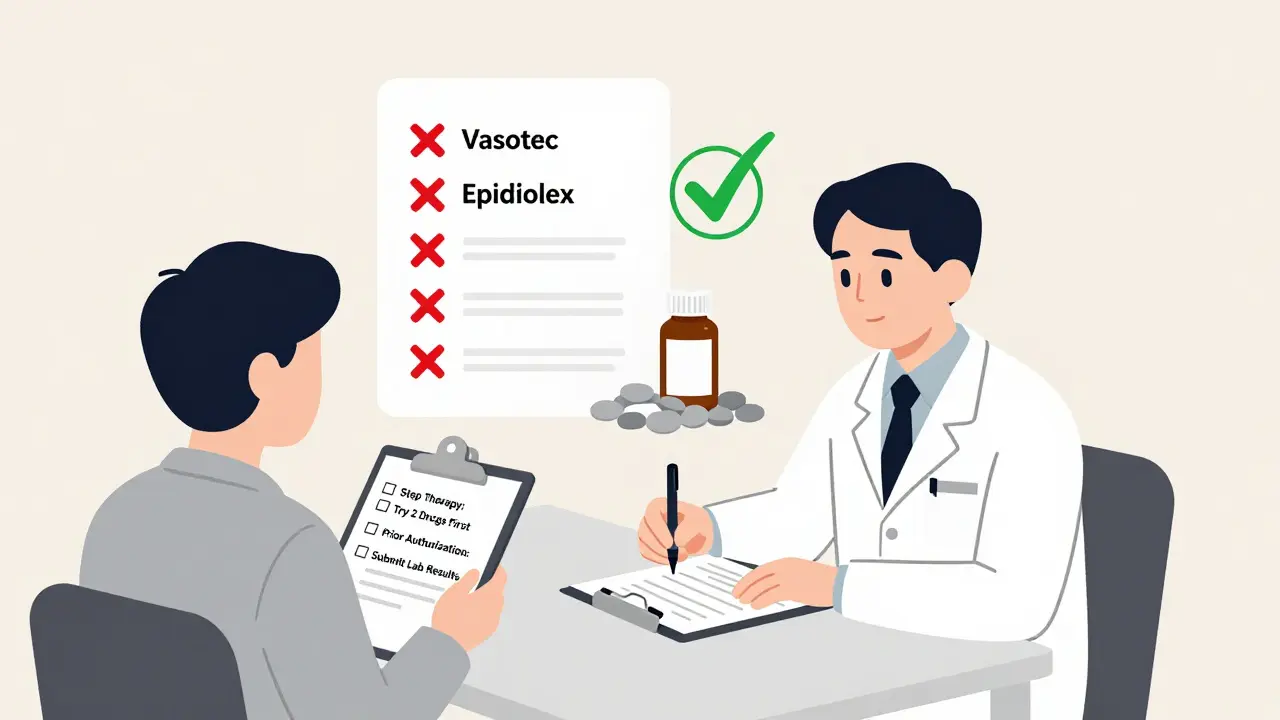
What Drugs Are Often Excluded?
States remove drugs from their formularies all the time-usually because they’re too expensive or don’t offer rebates. In North Carolina’s 2025 update, they dropped these:- Vasotec Tablet
- Acanya Cream
- Trulance Tablet
- Uceris Rectal Foam
- Epidiolex® Solution (moved from preferred to non-preferred)
Extra Help: A Lifeline for Low-Income Beneficiaries
If you qualify for Medicaid, you automatically qualify for Extra Help (also called the Low-Income Subsidy). This is a federal program that cuts your Medicare Part D drug costs even further. In 2025:- $0 monthly premium
- $0 deductible
- $4.90 copay for generics
- $12.15 copay for brand-name drugs
- After you hit $2,000 in total drug costs, you pay $0 for everything else
State-by-State Differences Are Real
Florida lets doctors use a quick-reference guide for injectable drugs. North Carolina requires detailed clinical notes for insulin users with Type 1 Diabetes. Some states let you get 90-day supplies through mail-order pharmacies. Others force you to use local pharmacies. States like California and New York have more flexible formularies. States in the South and Midwest? Often stricter. The same drug might be covered in Texas but not in Alabama. That’s because each state negotiates its own deals with pharmacy benefit managers (PBMs) like CVS Caremark, Express Scripts, and OptumRx.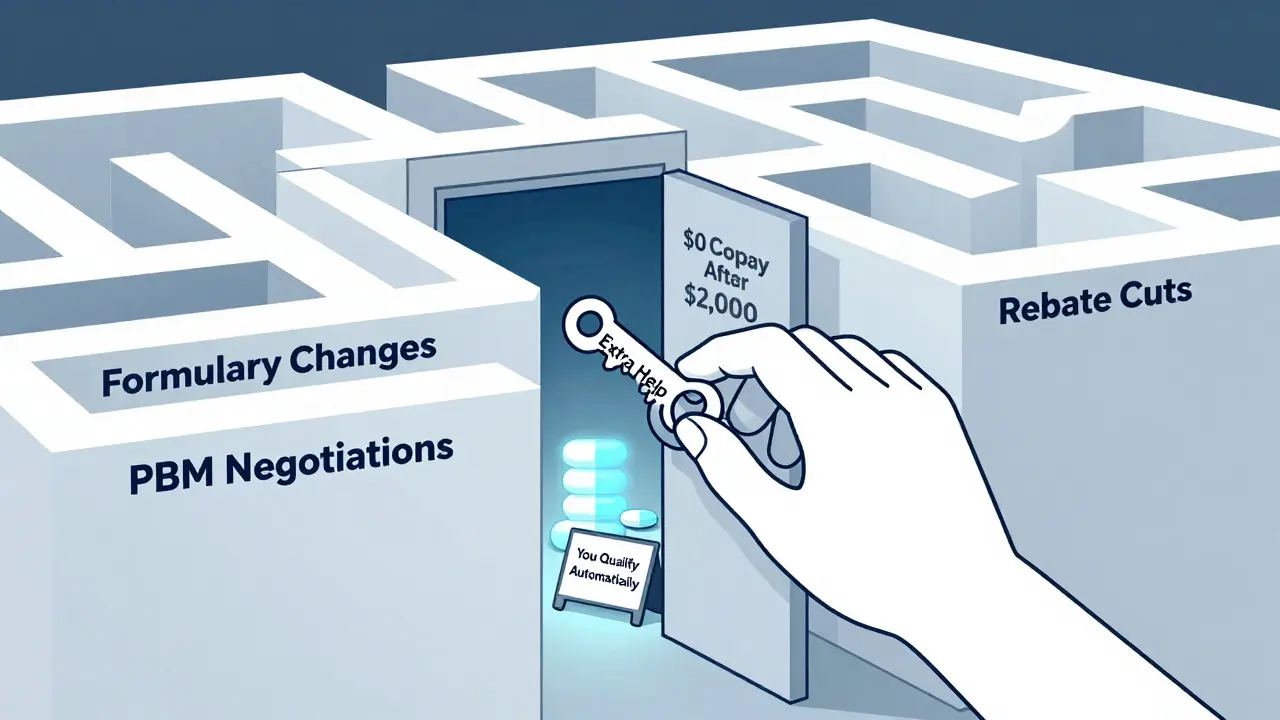
What You Can Do to Get Your Meds
If you’re struggling:- Check your state’s current PDL. Most are online-search “[Your State] Medicaid Preferred Drug List.”
- Ask your pharmacy if they’re in-network. Out-of-network pharmacies won’t bill Medicaid.
- If your drug is denied, ask your doctor for a letter of medical necessity. It’s not magic-but it works. 78% of denied claims get overturned when this is included.
- Call your State Health Insurance Assistance Program (SHIP). They offer free, one-on-one help. New beneficiaries usually need about 2.7 sessions to understand their coverage.
- Don’t assume your drug is gone forever. Formularies change every few months. A drug removed in July might be added back in October.
What’s Changing in 2026?
The federal government is tightening the rules. In Q1 2026, CMS will require states to prove their formulary restrictions don’t block medically necessary care. That’s a big shift. States can’t just cut drugs because they’re expensive-they have to show they’re not hurting patient health. Also, the Inflation Reduction Act caps out-of-pocket drug costs at $2,000 per year for Medicare Part D users. That matters if you’re dual-eligible (on both Medicare and Medicaid). You’re now protected from sky-high bills for specialty drugs. And there’s more on the horizon: 12-15 new gene therapies are coming between 2025 and 2027, each costing over $2 million per treatment. States are already testing new payment models-like paying based on whether the drug actually works. This isn’t science fiction. It’s happening now.Bottom Line
Medicaid covers prescription drugs-but not everything. Your coverage depends on where you live, what drug you need, and whether it’s on your state’s list. Generics are easy. Brand names? Harder. Specialty drugs? Almost always require paperwork. The good news? You have rights. You can appeal. You can ask for help. And if you’re on Medicaid, you already qualify for Extra Help-no extra application needed. Don’t let confusion stop you from getting the meds you need. Know your formulary. Talk to your pharmacist. And don’t give up if you’re denied the first time.Does Medicaid cover all prescription drugs?
No. Medicaid covers outpatient prescriptions, but each state creates its own list of approved drugs called a Preferred Drug List (PDL). Some drugs are excluded because they don’t offer rebates, are too expensive, or have cheaper alternatives. You may need prior authorization or must try other drugs first.
Why do some states deny my medication even if it’s prescribed?
States use step therapy and prior authorization to control costs. Step therapy means you must try cheaper drugs first. Prior authorization requires your doctor to prove the drug is medically necessary. If paperwork is missing or doesn’t meet criteria, the claim is denied-even if your doctor ordered it.
Can I get my prescription through mail order?
Yes, but only if your state and plan allow it. Many states encourage or require maintenance medications (like blood pressure or diabetes drugs) to be filled through mail-order pharmacies to save money. You’ll need to use a network pharmacy-check your plan’s list before ordering.
Do I have to pay copays for Medicaid prescriptions?
Yes, but it’s usually very low. Most states charge $1-$5 for generics and $10-$20 for brand names. If you qualify for Extra Help (automatic if you’re on full Medicaid), your copays drop to $4.90 for generics and $12.15 for brands, with $0 after you hit $2,000 in annual costs.
How do I find out what drugs are covered in my state?
Search for your state’s official Medicaid website and look for “Preferred Drug List” or “Formulary.” For example, North Carolina publishes its list at medicaid.nc.gov. You can also call your state’s SHIP program for free help navigating the list.
What if my drug gets removed from the formulary?
Your state must notify you before removing a drug. You can ask your doctor to file a prior authorization request, citing medical necessity. Some states allow exceptions for chronic conditions or if no alternatives exist. Keep checking the formulary-drugs are sometimes added back after a few months.
Is Extra Help the same as Medicaid?
No. Extra Help is a federal program that lowers your Medicare Part D drug costs. If you’re on full Medicaid, you automatically qualify for Extra Help-you don’t need to apply. It reduces your copays, eliminates deductibles, and caps your annual spending at $2,000.
Can I switch my prescription drug plan under Medicaid?
Yes. Starting in 2025, Medicaid beneficiaries can change their drug coverage once per month. You’re no longer stuck until the annual enrollment period. Contact your state’s Medicaid office or your pharmacy benefit manager to make changes.


Vikas Meshram
February 28, 2026 AT 10:42