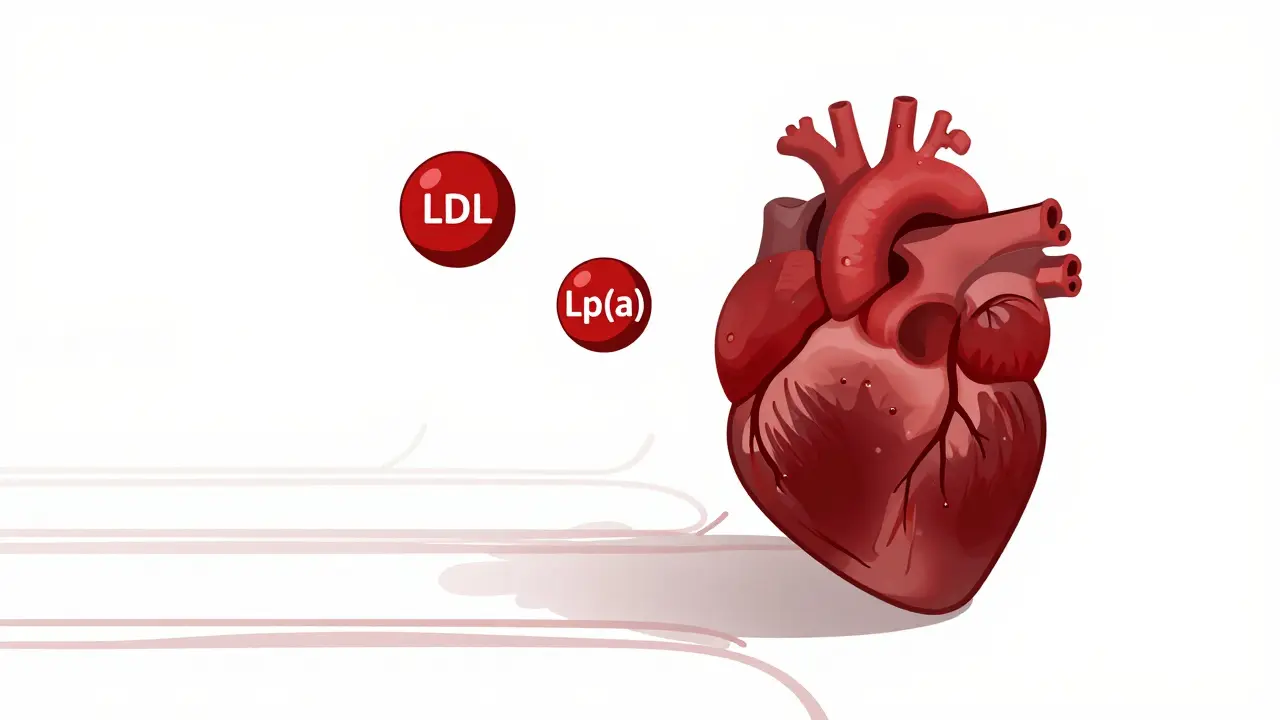
Most people know about LDL cholesterol - the so-called "bad" cholesterol - and how it contributes to heart disease. But there’s another cholesterol particle hiding in plain sight, one that doesn’t show up on routine blood tests and isn’t affected by diet or exercise: lipoprotein(a), or Lp(a). It’s not a typo. It’s not a buzzword. It’s a genetically inherited risk factor that can silently raise your chance of a heart attack or stroke - even if your other cholesterol numbers look perfect.
What Is Lipoprotein(a), Really?
Lipoprotein(a), or Lp(a), is a type of cholesterol-carrying particle in your blood. Think of it like LDL cholesterol - the kind that builds up in your arteries - but with a dangerous extra piece attached: a protein called apolipoprotein(a). This extra piece makes Lp(a) stickier and more inflammatory. It doesn’t just clog arteries; it also interferes with your body’s ability to break down blood clots, making heart attacks and strokes more likely.
It was first discovered in 1963, but for decades, doctors didn’t take it seriously. That’s changing fast. Today, experts agree: Lp(a) is one of the strongest inherited risk factors for cardiovascular disease. About 1 in 5 people - or 20% of the global population - have elevated levels. And unlike other cholesterol types, your Lp(a) level is mostly set at birth. Your genes decide it. Not your diet. Not your workout routine. Not even your weight.
Why Is Lp(a) So Dangerous?
Lp(a) doesn’t just add to your cholesterol burden - it multiplies your risk. High levels directly contribute to three deadly processes:
- Plaque buildup: Lp(a) delivers cholesterol into artery walls, fueling the growth of fatty plaques that narrow blood vessels.
- Plaque inflammation: It triggers immune responses that make plaques unstable and more likely to rupture - the main cause of heart attacks.
- Clotting problems: The apolipoprotein(a) part of Lp(a) mimics a protein involved in clot breakdown. This blocks your body’s natural clot-dissolving system, letting dangerous clots form and stick around.
The result? Higher risk of coronary artery disease, heart attack, stroke, peripheral artery disease, and even aortic valve stenosis - a condition where the heart’s main valve narrows and doesn’t open fully. Studies show that people with Lp(a) levels above 50 mg/dL (or 125 nmol/L) have a risk of heart attack or stroke equal to someone with familial hypercholesterolemia - a well-known genetic disorder that causes extremely high cholesterol from birth.
How Do You Know If You Have High Lp(a)?
This is the big problem: you won’t know unless you ask for the test.
Standard lipid panels - the ones doctors order during annual checkups - don’t include Lp(a). You have to specifically request it. And many doctors still don’t think to order it, especially if your LDL, HDL, and triglycerides are normal.
That’s changing. Major organizations like the American Heart Association and the American College of Cardiology now recommend that everyone get tested for Lp(a) at least once in their lifetime. But the strongest push is for people with:
- A family history of early heart disease (before age 55 for men, before age 65 for women)
- A personal history of heart attack, stroke, or blocked arteries at a young age
- A diagnosis of familial hypercholesterolemia
- Unexplained cardiovascular disease despite normal cholesterol levels
And here’s something else to consider: Lp(a) levels vary by race and gender. Black individuals tend to have naturally higher levels than white, Hispanic, or Asian populations. Women often see their Lp(a) rise after menopause, likely because estrogen - which helps suppress Lp(a) - drops. But no matter your background, higher Lp(a) = higher risk. Always.

Can You Lower Lp(a) With Lifestyle Changes?
Here’s the hard truth: no.
Unlike LDL cholesterol, which drops with a healthier diet, weight loss, or more exercise, Lp(a) barely budges. Eating less saturated fat won’t help. Running marathons won’t lower it. Taking fish oil or plant sterols? No effect.
The American Heart Association still recommends living a heart-healthy lifestyle - because it lowers your overall risk from other factors. But if your Lp(a) is high, you can’t rely on lifestyle alone. You need a different strategy.
What About Medications?
Statins - the go-to drugs for lowering cholesterol - don’t reduce Lp(a). In fact, they might slightly raise it. Niacin (vitamin B3) can lower Lp(a) by 20-30%, but it causes serious side effects like flushing, liver damage, and high blood sugar. Most doctors won’t recommend it anymore.
But there’s new hope. A new class of drugs called antisense oligonucleotides (ASOs) is showing dramatic results. One drug, pelacarsen, has been shown in clinical trials to lower Lp(a) by up to 80%. That’s not a small change - it’s a game-changer.
The big question: does lowering Lp(a) actually prevent heart attacks and strokes? That’s what the Lp(a) HORIZON Outcomes Trial is trying to answer. This phase 3 trial is following high-risk patients with very high Lp(a) levels (≥90 mg/dL) who are getting pelacarsen. Results are expected in 2025. If the data confirms what early trials suggest, this could be the first treatment specifically approved to target Lp(a) and reduce cardiovascular events.

What Should You Do Right Now?
If you’ve never been tested for Lp(a), here’s your action plan:
- Ask your doctor: Say, "Can I get my Lp(a) level checked? I want to know my full genetic risk for heart disease." Don’t let them brush you off.
- Get the right test: Make sure they’re measuring it in nmol/L - not just mg/dL. The newer units are more accurate and standardized. Ask for the lab’s reference range.
- Understand your number: Levels above 50 mg/dL (or 125 nmol/L) are considered high risk. Above 90 mg/dL (190 nmol/L) is very high risk.
- Manage what you can: Even if your Lp(a) is high, controlling your blood pressure, blood sugar, and LDL cholesterol matters. Don’t skip your statin if you need it - it helps with other risks.
- Screen your family: If you have high Lp(a), your children, siblings, and parents should get tested too. It’s inherited - 50% chance if one parent has it.
What’s Next for Lp(a)?
The field is moving fast. In the next few years, we’ll likely see:
- More widespread testing - possibly included in routine panels
- Standardized lab methods so results are consistent across hospitals
- Approval of the first Lp(a)-lowering drugs, like pelacarsen
- Guidelines that recommend aggressive LDL lowering for people with high Lp(a)
For now, the message is clear: Lp(a) isn’t a mystery anymore. It’s a measurable, inheritable, and dangerous risk - but one that’s finally getting the attention it deserves. If you’ve had unexplained heart problems, or if heart disease runs in your family, don’t wait for your doctor to bring it up. Ask for the test. Knowledge here isn’t just power - it’s prevention.
Is lipoprotein(a) the same as LDL cholesterol?
No. Lp(a) is a separate particle that includes an LDL-like core but has an extra protein called apolipoprotein(a) attached. This makes it more likely to cause plaque buildup and blood clots. Standard cholesterol tests don’t measure Lp(a), so you need a specific test for it.
Can diet and exercise lower Lp(a)?
No. Unlike LDL cholesterol, Lp(a) levels are mostly determined by your genes - not lifestyle. Eating healthy and exercising won’t significantly lower your Lp(a), but they’re still important to reduce your overall heart disease risk.
Who should get tested for Lp(a)?
Everyone should consider testing at least once. But it’s especially important if you have early heart disease, a family history of heart attacks or strokes before age 55-65, familial hypercholesterolemia, or unexplained cardiovascular events despite normal cholesterol levels.
Is Lp(a) more common in certain ethnic groups?
Yes. Black individuals tend to have higher average Lp(a) levels than white, Hispanic, or Asian populations. Women’s levels often rise after menopause due to falling estrogen. But regardless of background, higher Lp(a) always means higher risk.
Are there new drugs coming to treat high Lp(a)?
Yes. A drug called pelacarsen, part of a new class called antisense oligonucleotides, has shown it can lower Lp(a) by up to 80% in trials. The final results from the large Lp(a) HORIZON trial are expected in 2025. If proven effective at preventing heart attacks and strokes, it could become the first approved therapy specifically for high Lp(a).


Thomas Anderson
December 16, 2025 AT 10:05