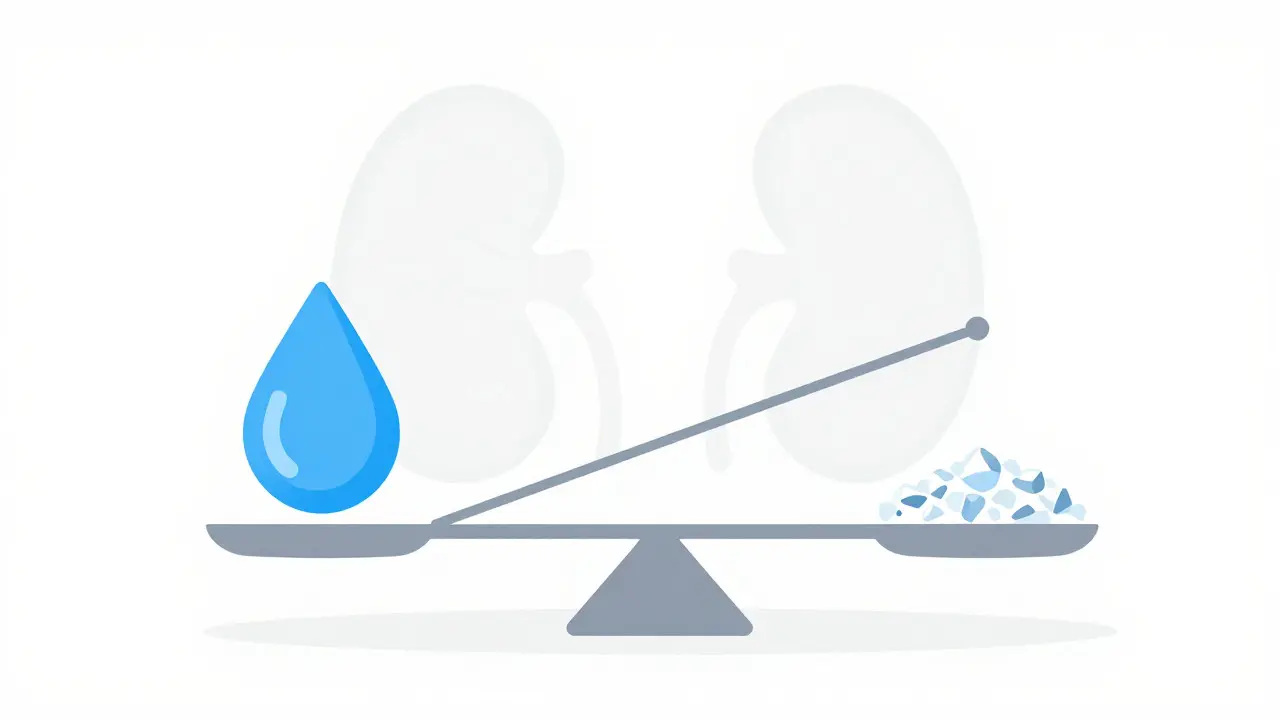
Imagine your body is a delicate balance scale. On one side sits water; on the other, salt (sodium). In a healthy body, your kidneys act as the master adjusters, constantly tweaking these weights to keep you stable. But when Chronic Kidney Disease (CKD) sets in, those scales get stuck. The result? Your blood sodium levels swing wildly-either dropping too low (hyponatremia) or spiking too high (hypernatremia). For the millions living with kidney issues, this isn't just a lab value to worry about. It’s a daily tightrope walk that affects everything from your brain function to your risk of falling.
You might think eating less salt is always good for your kidneys. But in advanced CKD, restricting solutes like sodium and protein can actually backfire, making it harder for your kidneys to excrete free water. This paradox increases the risk of hyponatremia, a condition where your blood becomes dangerously diluted. Understanding how your failing kidneys handle sodium and water is the first step to staying safe and avoiding hospital visits.
How Kidneys Control Sodium and Water
To understand why sodium disorders happen, we have to look at what goes wrong inside the nephron-the tiny filtering units of your kidney. In a healthy person, the glomerulus filters blood, and the tubules reabsorb exactly what the body needs while dumping the rest. As Glomerular Filtration Rate (GFR) declines in CKD, this system breaks down. The remaining nephrons have to work overtime, but they often fail to maintain the precise balance required.
The kidney regulates sodium concentration through two main levers: excreting sodium/potassium salts and producing urine that is either very dilute or very concentrated. This process is directed by Vasopressin (Antidiuretic Hormone or ADH). When your blood is salty, vasopressin drops, and you pee out lots of dilute water. When you’re dehydrated, vasopressin rises, and you conserve water. In CKD, structural damage to the tubules and the medullary interstitium blunts this response. Your kidneys lose their ability to make truly dilute urine or highly concentrated urine. This state, known as hyposthenuria or isosthenuria, means your body loses its buffer against changes in fluid intake.
There are three distinct patterns of fluid imbalance seen in CKD patients:
- Mild ECF Volume Expansion: Seen in 60-70% of early CKD cases. This leads to salt-sensitive hypertension and strain on the heart (left ventricular hypertrophy).
- Severe ECF Volume Expansion: Often linked to nephrotic syndrome, causing significant swelling (edema).
- Salt-Wasting Syndromes: Less common but dangerous, where the kidneys dump too much salt, leading to volume contraction and dehydration.
As GFR falls below 30 mL/min/1.73m² (Stages 4-5 CKD), the range of water intake that keeps your sodium normal shrinks dramatically. You become vulnerable to both low and high sodium levels depending on how much you drink and eat.
Hyponatremia: The Danger of Dilution
Hyponatremia is defined as a serum sodium level below 135 mmol/L. In the context of CKD, it is far more common than hypernatremia. Why? Because as kidney function fails, the ability to excrete free water diminishes faster than the ability to excrete salt. If you drink a large glass of water, your healthy kidneys would flush it out quickly. A CKD patient might retain that water, diluting the sodium already in their blood.
This isn't just a number on a chart. Hyponatremia carries serious risks. Studies show it is linked to cognitive decline, gait instability, and a significantly higher risk of falls and fractures. In elderly CKD patients, the prevalence of gait instability jumps to 28% in those with hyponatremia compared to 12% in those with normal sodium. The mortality risk is also stark: hospitalized patients with hyponatremia face a 28% higher mortality rate than those with normal levels.
We classify hyponatremia in CKD based on your total body water status:
| Type | Prevalence in CKD | Primary Cause |
|---|---|---|
| Euvolemic | 60-65% | Impaired water excretion due to low GFR; often worsened by thiazide diuretics. |
| Hypovolemic | 15-20% | Volume loss from diuretics, vomiting, or salt-wasting syndromes. |
| Hypervolemic | 15-20% | Fluid overload from advanced CKD, edema, or concurrent heart failure. |
A critical insight from recent research (PMC11828805, 2023) is that standard dietary advice for CKD-which often restricts protein and sodium to manage potassium and acidosis-can inadvertently cause hyponatremia. Without enough solute (salt/protein) in the urine, the kidney cannot excrete water efficiently. So, ironically, being "too healthy" with your diet can sometimes trigger low sodium in late-stage CKD.
Hypernatremia: The Risk of Concentration
Hypernatremia, defined as serum sodium above 145 mmol/L, is less common but equally dangerous. It usually occurs when there is a net loss of water greater than the loss of sodium. In CKD patients, this often happens because the kidneys lose the ability to concentrate urine maximally. If you don’t drink enough water to replace losses from sweating, fever, or osmotic diuresis, your sodium levels spike.
Hypernatremia causes cells to shrink as water moves out of them to balance the high sodium outside. In the brain, this can lead to confusion, seizures, and even permanent neurological damage if corrected too quickly. The key here is access to water. Many elderly CKD patients suffer from impaired thirst mechanisms or physical limitations that prevent them from drinking enough, putting them at high risk for hypernatremia.
Treatment Strategies: Precision Over Prescription
Treating sodium disorders in CKD requires a nuanced approach. One size does not fit all. In fact, applying standard protocols without adjusting for reduced kidney function is a leading cause of complications, including osmotic demyelination syndrome-a severe neurological injury caused by correcting sodium too fast.
For Hyponatremia:
- Fluid Restriction: This is the first-line treatment. However, the target depends on your stage. Early CKD patients might need to limit fluids to 1,000-1,500 mL/day, while advanced CKD patients may need stricter limits of 800-1,000 mL/day.
- Correction Speed: Never correct sodium faster than 4-6 mmol/L in the first 24 hours. The absolute maximum is 8 mmol/L in 24 hours. Going faster risks tearing the myelin sheaths off nerve cells in the brain.
- Medication Review: Thiazide diuretics are notorious for causing hyponatremia in CKD. If your GFR is below 30 mL/min, thiazides are often ineffective anyway and should be switched to loop diuretics under doctor supervision.
For Hypernatremia:
- Water Replacement: The goal is to slowly lower sodium levels. Do not exceed a correction rate of 10 mmol/L in the first 24 hours to avoid cerebral edema (brain swelling).
- Identify Losses: Determine if the water loss is from the kidneys (osmotic diuresis) or extra-renal sources (sweating, GI losses) to tailor replacement therapy.
Dr. Richard H. Sterns, a leading expert in electrolyte disorders, notes that the most common error in managing CKD-related hyponatremia is failing to recognize the kidney's reduced capacity to excrete water. This leads doctors to prescribe IV fluids that the patient simply cannot get rid of, worsening the dilution.
Navigating Dietary Restrictions and Medications
If you have CKD, you likely hear about restrictions constantly. Limit sodium. Limit potassium. Limit protein. Limit fluids. It’s overwhelming. But understanding the interaction between these factors is key to preventing sodium disorders.
The Solute Paradox: As mentioned, sodium and protein provide the "solutes" needed to excrete water. If you severely restrict protein and salt, your urine output drops, and free water retention rises. For some advanced CKD patients, a moderate increase in salt intake (under strict medical supervision) might actually help prevent hyponatremia by allowing the kidneys to flush out excess water. This is counterintuitive but supported by recent nephrology guidelines.
Medication Watch:
- Thiazide Diuretics: High risk for hyponatremia, especially if eGFR <30. FDA warnings highlight this risk.
- Vaptans (Vasopressin Antagonists): Drugs like tolvaptan are used for hyponatremia but are generally contraindicated in advanced CKD because the kidneys respond poorly to them, and liver toxicity risks exist.
- NSAIDs: Can reduce blood flow to the kidneys, worsening both GFR and sodium handling.
Successful management requires a team. Studies show that integrated care models involving nephrologists, dietitians, and pharmacists can reduce hospitalizations for sodium disorders by 35%. Don't try to navigate this alone. Ask your renal dietitian specifically about your "free water clearance" capacity.
Monitoring and Future Technologies
Traditional monitoring involves periodic blood tests. But sodium levels can change rapidly. In 2023, the FDA approved a novel sodium monitoring patch for CKD patients. This device provides continuous interstitial sodium measurements, correlating strongly (85%) with serum sodium levels. While not yet ubiquitous, technologies like this represent the future of personalized electrolyte management, allowing for real-time adjustments rather than reactive crisis management.
Until then, self-monitoring is crucial. Weigh yourself daily. Sudden weight gain indicates fluid retention (risk of hyponatremia/hypervolemia). Sudden weight loss may indicate dehydration (risk of hypernatremia). Track your symptoms: confusion, nausea, muscle cramps, or unsteadiness are red flags that require immediate medical attention.
What are the early signs of hyponatremia in kidney disease?
Early signs include subtle cognitive changes like difficulty concentrating, mild nausea, headache, and muscle weakness. In older adults, it often presents as increased unsteadiness or a higher frequency of falls. If you feel "foggy" or unusually tired after drinking water, check your sodium levels.
Can I drink water freely if I have Stage 3 CKD?
Usually, yes. In Stage 3 CKD (GFR 30-59), your kidneys still have significant reserve. However, if you are on diuretics or have heart failure, your doctor may advise specific limits. Always follow your nephrologist's individualized fluid prescription, as general advice doesn't account for your specific medication regimen.
Why do doctors restrict salt if too little salt causes hyponatremia?
Salt restriction primarily controls blood pressure and prevents fluid overload (hypervolemia), which strains the heart. The risk of hyponatremia from low salt is mostly relevant in advanced CKD (Stage 4-5) where water excretion is severely impaired. In earlier stages, the benefit of blood pressure control outweighs the hyponatremia risk. It is a balancing act managed by your care team.
Is hypernatremia more dangerous than hyponatremia?
Both are dangerous but in different ways. Hyponatremia is more common and linked to chronic issues like falls and cognitive decline. Hypernatremia is often an acute emergency indicating severe dehydration. Rapid correction of either can cause fatal brain injuries (cerebral edema for hypernatremia, osmotic demyelination for hyponatremia). Both require careful, slow correction in a hospital setting if severe.
How does diet affect sodium levels in advanced CKD?
In advanced CKD, protein and salt intake determine your ability to excrete water. Very low solute intake reduces urine volume, trapping water in the body and diluting sodium. Some patients may need slightly higher solute intake to facilitate water loss, but this must be balanced against risks of high potassium and acidosis. Consult a renal dietitian for a personalized plan.