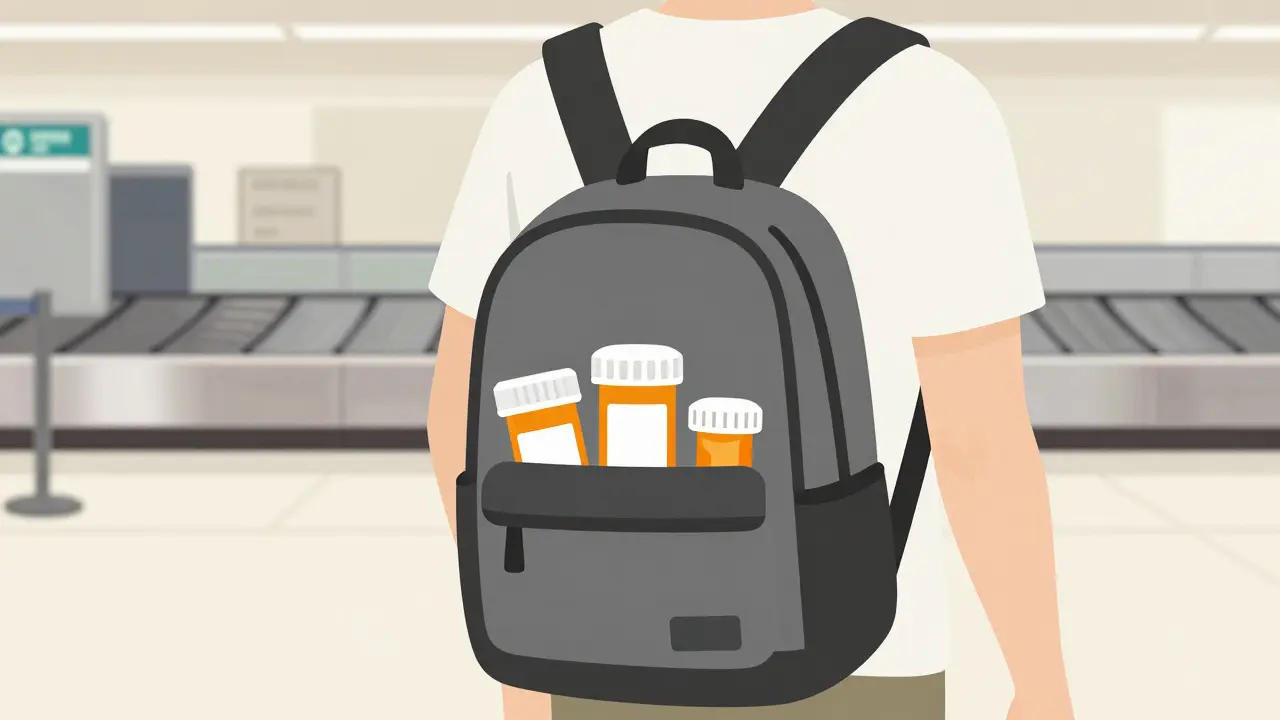
The Risk of Lost Luggage and Meds
Imagine arriving at your destination and realizing you've lost your blood pressure pills or insulin because you checked the bag containing them. This is not a nightmare scenario; it happens more often than you think. According to industry reports from SITA regarding their 2022 Baggage Report, there is roughly a 0.02% annual rate of lost luggage globally. That might sound small, but if you depend on specific medications, even one missed dose could ruin your trip or cause health issues.
The golden rule for any journey is simple: keep your prescriptions in your carry-on luggage. Whether you are heading out for a cross-country road trip or boarding a vessel for two weeks, your personal medical supplies belong in the cabin, not the cargo hold. Airlines can misplace checked bags, and ships can delay delivery to staterooms for days. By keeping meds on your person or in your hand-luggage, you maintain total control over your inventory.
The Container Rule and TSA Regulations
One of the most common mistakes travelers make involves how they pack their pills. You might be tempted to transfer all your weekly doses into a small plastic pill box to save space. Do not do this when flying or crossing borders. The Transportation Security Administrationsets security standards for air travel and medication allowances, commonly known as the TSA, has clear guidelines on this. While they allow liquids over 3 ounces if declared as medically necessary, they strictly prefer that medications remain in their original pharmacy containers.
Why? Because security officers cannot verify what is inside an unlabeled container. At land borders, especially when entering countries with strict import laws, an agent sees a bag of white pills and doesn't know if it's ibuprofen or a controlled substance. If the name on the prescription label doesn't match the name on your passport, you risk having the medication confiscated immediately. Always keep your United States Customs and Border Protectionfederal agency responsible for controlling goods entering the country documents handy, too. The U.S. CBP mandates that prescription drugs show a matching name between the traveler and the bottle.
Documenting Your Health Needs
Packing is only half the battle; documentation is the other. A simple printout of your prescription isn't always enough for international travel. You should carry a formal letter from your primary care physician. This letter should include your full medical history, a list of your generic drug names, dosages, and why you need them. For complex regimens, consider getting this translated into the primary language of your destination country.
The Centers for Disease ControlU.S. government public health agency providing travel health advice strongly advises creating a medication list in both physical and digital formats. Why digital? If your paper documents get soaked or lost, you can instantly show the file on your phone to local doctors. Many travelers forget that communication barriers exist overseas. About 12% of travelers experience trouble communicating their medical needs to foreign providers, so having a clear, standardized list bridges that gap effectively.
| Item | Requirement | Notes |
|---|---|---|
| Prescription Bottle | Original Pharmacy Label | Name must match passport |
| Doctor's Letter | Official Letterhead | Include generic and brand names |
| Emergency Contacts | Card with Phone Numbers | Include insurance provider details |
| Digital Copy | Email to Self | Keep accessible offline |
Cruising: Strict Rules for Sea and Land
Sailing introduces a layer of complexity that road trips don't have. Ships operate under maritime law, meaning they visit different jurisdictions daily. Major lines like Royal Caribbean InternationalMajor cruise line with strict onboard medication policies explicitly state that guests should transport all medications in carry-on luggage. Their policy was updated in early 2024 to minimize the potential for diversion or loss.
There is another reason for caution: port inspections. When you dock in a foreign country, their local police may board the ship. If they find unlabelled pills in your cabin safe, you could face fines or even arrest before you even leave the boat. Some destinations require special permits for common drugs. For example, certain painkillers or ADHD medications that are legal in the U.S. are controlled substances in parts of Asia or the Middle East.
If you take controlled substances, you must declare them. Norwegian Cruise LineCruise company requiring advance declaration of controlled substances requires passengers to declare controlled substances up to 30 days before sailing. Carnival follows suit, demanding physician documentation for Schedule II substances. Ignoring this step usually leads to denied boarding. Unlike a road trip where you just drive through a border, missing a deadline on a cruise means waiting for the ship to dock at the next port, which could be hours or days away.
Road Tripping: State Laws and Climate Control
Driving allows you access to pharmacies, but it brings its own risks. On a long drive, you traverse multiple states or provinces with different laws. Medical marijuana is approved in many places but illegal in others. Even standard prescriptions like opioids can trigger alarms if stopped at a state checkpoint without proof of ownership. The American Automobile Association reports that nearly 67% of members experienced medication-related issues while traveling across state lines, mostly due to varying enforcement of medical cannabis laws.
The environment inside your vehicle is also dangerous for sensitive meds. An RV parked in the sun can reach temperatures of 120°F (49°C) or higher, destroying insulin or biologics. Always store temperature-sensitive drugs in a cooler or insulated case. However, never let ice directly touch the medication. If you are driving, check the temperature inside your car before you park the vehicle overnight. Using a thermoelectric cooler plugged into your vehicle's power outlet ensures your meds stay within the safe range of 59°F to 86°F (15°C - 30°C).
Packing Systems and Organization
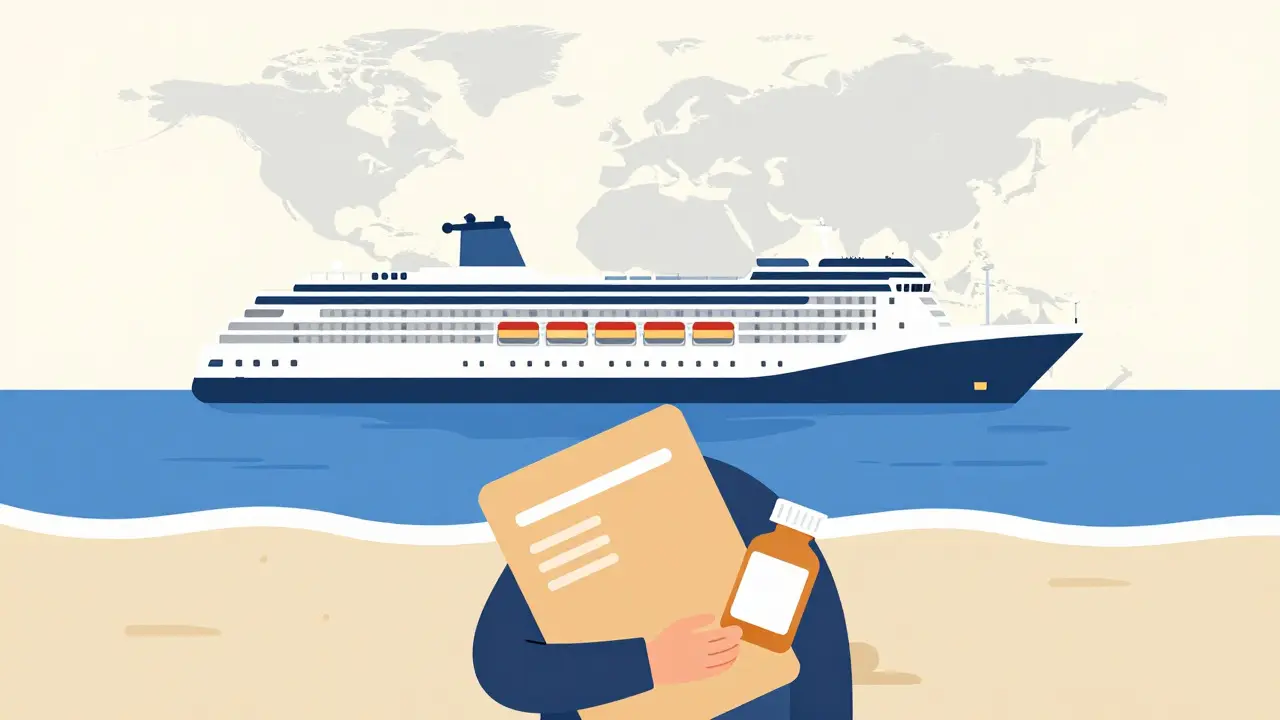
Organization prevents dosage errors. A common system recommended by travel specialists involves unit-dose packaging or blister cards. These pre-packaged systems place one pill per bubble or envelope, labeled with the time of day. If you buy your own containers, you must tape them shut and label them clearly. Labels must include your name, date, time, and pill count. Unlabeled containers look suspicious to security.
For cruises, some experts recommend separating medications by type using color-coded Ziplock bags. Place all heart meds in blue, diabetes meds in red, etc. Put these bags inside a waterproof sleeve along with your medical documents. This setup allows you to grab exactly what you need in minutes if you feel faint, without rummaging through a cluttered tote bag.
Customs and International Restrictions
Every country has sovereign rights to decide what enters their borders. You might have a perfectly legal script for Adderall in the U.S., but that same drug is a felony-level offense in Singapore. Before booking your ticket, check the entry requirements of every country on your itinerary. The World Health Organization noted in their 2022 International Travel Medication Report that 18% of common medications are restricted in at least one major travel destination.
To navigate this, use resources like Smartraveller from the Australian Government or the CDC website. Look for lists titled "Restricted Medications" or "Controlled Drugs." If you are unsure, email the embassy of the country you plan to visit with your doctor's note attached. Asking ahead avoids panic at the airport gate.
Can I put my liquid medication in my carry-on bag?
Yes, liquid medications like cough syrup or eye drops are exempt from the standard 3.1.1 liquid rule. You must declare them to security officers at the screening checkpoint. Keep them separate from toiletries so they can be inspected quickly.
What should I do if I run out of medication on a cruise?
Shipboard medical centers are equipped to treat emergencies, but they rarely stock personal maintenance medications. Always bring a minimum of three extra days' supply beyond your itinerary. Contact your ship's medical officer if you absolutely need assistance filling a partial refill in port.
Is it safe to pack insulin in a suitcase?
Is it safe to pack insulin in a suitcase?
No. Insulin is highly sensitive to heat and cold. Never check insulin. Keep it in your carry-on with a portable cooler case. Do not freeze your insulin; extreme cold can damage the structure of the drug.
Do I need permission to travel with medical cannabis?
Generally, no. Most cruise lines and airports prohibit cannabis entirely, regardless of state laws. Federal jurisdiction applies to air travel and maritime boundaries, making possession a violation of federal policy. Research specific country laws carefully if traveling internationally.
How far in advance should I prepare my docs?
Start at least 30 days before departure. Gathering a doctor's letter and verifying destination laws takes time. Some cruise lines now require electronic submission of medication lists up to 72 hours before sailing, so book early.