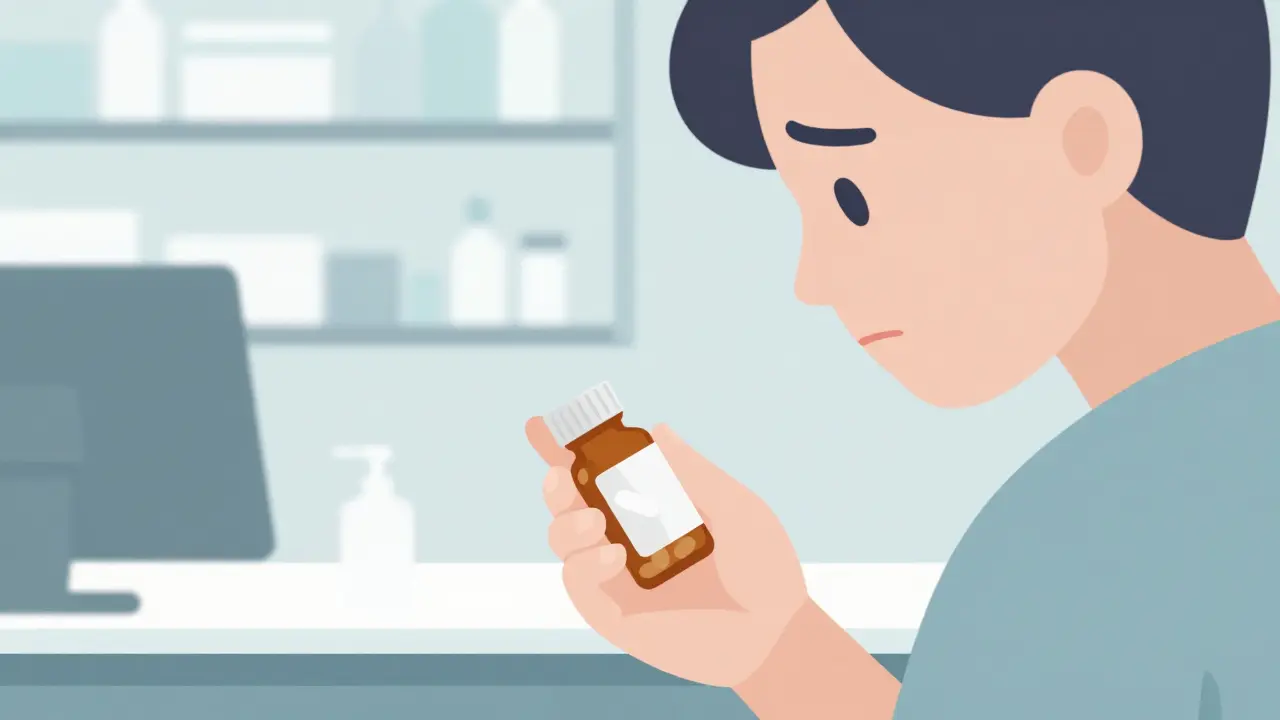
Picture this: A regular customer walks up to your counter. They’ve been taking a specific blue oval pill for years. Today, the bottle contains white rectangles. Their face drops. “Is this even the same medicine?” they ask, voice tight with worry. This isn’t just about a change in color; it’s a moment where trust is tested. As pharmacists, we see this hesitation daily. It’s not stubbornness-it’s fear. Fear that their health is at risk because of a cost-cutting measure they don’t understand.
Generic medications are the backbone of modern healthcare, representing over 90% of prescriptions dispensed in the United States alone. Yet, despite their proven safety and efficacy, patient resistance remains a significant barrier. Research indicates that nearly a third of patients express concerns about switching from brand-name drugs to generics. When we fail to address these concerns effectively, the consequences go beyond lost sales or administrative friction. We risk non-adherence, poor health outcomes, and unnecessary strain on the healthcare system. The goal isn’t just to dispense the cheaper option; it’s to ensure the patient feels confident enough to take it.
Why Patients Doubt Generics: It’s Not Just About Price
To fix the problem, we first have to understand the root cause. Most providers assume patients reject generics because they don’t want to pay more. But data tells a different story. According to surveys by the FDA, 43% of patients believe generic drugs contain only 80% of the active ingredients found in brand-name versions. That’s a massive misconception. Another major hurdle is appearance. A 2019 study from the University of Michigan found that 78% of patients cite pill size, shape, or color as a primary reason for distrust. When a familiar blue pill becomes a white tablet, the brain registers a threat, not a savings opportunity.
This hesitation stems from a lack of awareness about regulatory standards. The Food and Drug Administration (FDA) established strict bioequivalence requirements through the Hatch-Waxman Act of 1984. For a generic to be approved, it must demonstrate that it delivers the same amount of active ingredient into the patient’s bloodstream within the same timeframe as the brand-name drug. The acceptable range is 80-125%, but statistically, most generics fall much closer to 100%. Despite these rigorous checks, only 32% of patients are aware of these standards, according to 2022 data from the National Community Pharmacists Association. Our job is to bridge this knowledge gap without sounding like a textbook.
The Power of Timing: Catching Concerns Early
When you talk to a patient about generics matters just as much as what you say. Ideally, the conversation should start at the point of prescribing, not dispensing. The FDA’s 2022 report highlights a stark contrast: 89% of patients accepted generic substitutions when educated by their prescriber beforehand, compared to just 63% when the discussion happened only at the pharmacy counter. By the time the prescription hits your system, the patient has often already formed an opinion-or a fear-based on internet forums or anecdotal stories.
In community pharmacy settings, where we are often the last line of defense, proactive communication is key. Waiting for a patient to complain about a new pill shape is too late. Instead, integrate generic education into your standard counseling workflow. If you know a switch is coming, mention it before handing over the bag. “Just a heads-up, your doctor switched you to a generic version of this medication. It works exactly the same way, but it might look a bit different.” This small shift transforms a potential crisis into a routine update. Proactive explanations achieve an 82% acceptance rate, whereas reactive responses drop that number to less than half.
Effective Communication Frameworks That Work
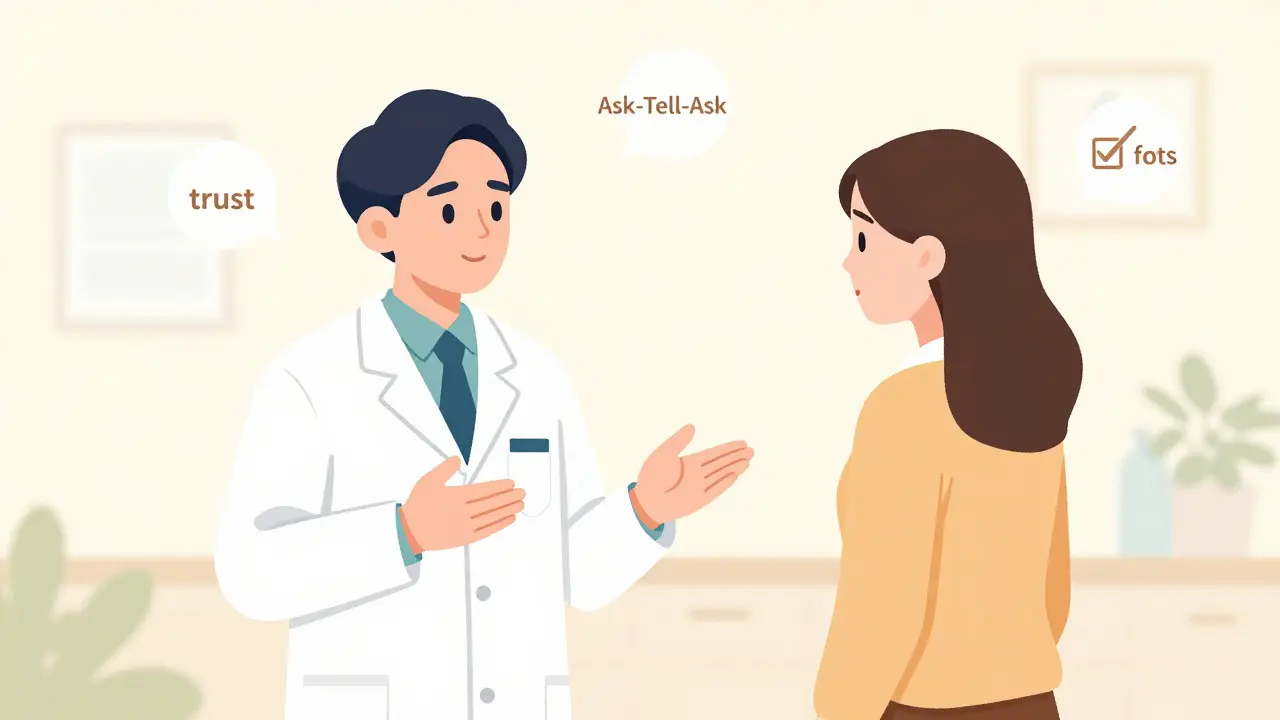
Telling a patient “It’s the same thing, just cheaper” rarely works. In fact, studies show this dismissive approach can reduce acceptance rates to 31%. Patients need empathy, not economics. Two frameworks have emerged as particularly effective in clinical practice: the Ask-Tell-Ask method and the VALUE technique.
The Ask-Tell-Ask Framework:
- Ask: Start by gauging their current understanding. “What have you heard about generic medications?” or “Do you have any concerns about this new prescription?”
- Tell: Provide clear, concise information tailored to their specific concern. If they’re worried about strength, explain bioequivalence. If they’re worried about side effects, reassure them about identical active ingredients.
- Ask: Verify comprehension. “Does that make sense?” or “How do you feel about trying this version?”
A landmark 2020 study published in the Journal of General Internal Medicine tracked over 1,200 patients and found that providers using this framework achieved a 68% acceptance rate, compared to 42% with standard communication. It turns a lecture into a dialogue.
The VALUE Technique:
For more complex hesitations, the VALUE acronym offers a structured emotional approach:
- Validate their concerns (“I understand why a different-looking pill would worry you.”)
- Acknowledge feelings (“It’s normal to feel cautious about changes to your medication.”)
- Listen actively (Let them finish speaking without interruption.)
- Understand their perspective (Identify if the issue is cost, efficacy, or appearance.)
- Educate with empathy (Share facts gently, focusing on safety and equivalence.)
Research from The U.S. Pharmacist shows this technique outperforms standard counseling with a 76% success rate. It respects the patient’s autonomy while guiding them toward evidence-based decisions.
Building Trust Through Personal Endorsement
Facts alone often fail to overcome emotional barriers. Trust is the currency of healthcare. When patients hesitate, they aren’t rejecting science; they’re seeking reassurance from someone they believe cares about their well-being. One of the most powerful tools in your arsenal is personal endorsement.
Data from the American Journal of Managed Care reveals that when providers state, “I prescribe this generic for my own family,” acceptance rates jump by 37 percentage points. Why does this work? It humanizes the recommendation. It signals that you aren’t just pushing a cost-saving measure for the insurance company; you genuinely believe in the product’s quality. You become a trusted advisor rather than an information librarian.
However, authenticity is crucial. Only use this statement if it’s true. Patients can detect insincerity. If you haven’t used the specific generic yourself, pivot to professional confidence: “This manufacturer has an excellent track record for quality, and I’ve seen thousands of patients thrive on this version.” The goal is to leverage the existing provider-patient relationship to fill the trust gap.
Navigating Common Objections with Specific Phrasing
Patients will raise specific objections. How you phrase your response determines whether they listen or tune out. Let’s look at three common scenarios and how to handle them effectively.
| Patient Objection | Ineffective Response | Effective Response | Impact on Acceptance |
|---|---|---|---|
| “Generics don’t work as well for me.” | “They are the same drug.” | “I hear that. Sometimes inactive ingredients differ, which can affect tolerance. Let’s review the specific differences in this formulation.” | +29% vs. -15% |
| “I’m worried about the price saving being low quality.” | “It’s cheaper because there’s no marketing cost.” | “The lower price comes from skipping expensive advertising campaigns, not cutting corners on the medicine itself. The active ingredient is identical.” | +29% vs. +7% |
| “My pills used to be blue and round.” | “Appearance doesn’t matter.” | “That’s a valid concern. The look changed because the manufacturer differs, but the inside-the part that treats your condition-is exactly the same.” | +37% vs. -10% |
Notice the pattern in the effective responses? They validate the patient’s feeling first, then provide a concrete explanation. Avoid focusing solely on cost. Dr. Thomas Moore’s analysis in JAMA Internal Medicine warned that overemphasizing savings can backfire, decreasing trust by 22% when it’s the sole justification. Patients care about their health first, their wallet second. Lead with efficacy, follow with economy.

Visual Aids and Digital Tools
For visual learners, words aren’t enough. A Healthcare Hotline survey found that 68% of patients would accept generics if shown visual comparison tools. Simple aids can demystify the process. Consider keeping counter mats or brochures that illustrate the bioequivalence testing process. Show a graph of how both brand and generic drugs release medication into the bloodstream over time. Seeing the overlapping curves provides tangible proof of equivalence.
Digital tools are also evolving. The FDA launched the ‘Generics Smart’ toolkit, which includes 3D pill comparison features. While not every pharmacy has VR headsets, simple QR codes linking to verified educational videos can empower patients to explore the information at their own pace. If a patient is skeptical, inviting them to look at the manufacturing standards together can turn suspicion into curiosity.
Collaborative Care: Bridging the Prescriber-Pharmacist Gap
No single provider can solve this issue alone. The American Medical Association’s 2022 module highlights that team-based approaches involving both prescribers and pharmacists boost generic acceptance to 85%. This is significantly higher than interventions led by pharmacists (67%) or physicians (59%) working in silos.
As a pharmacist, you can initiate this collaboration. Share feedback with local prescribers about which patients are struggling with transitions. Suggest that doctors include a brief note on the prescription explaining the switch. Even a simple “Switched to generic for equivalent efficacy” written on the script can preempt questions. Building a unified front ensures the patient hears a consistent message, reinforcing trust across the entire care continuum.
Implementation Challenges and Solutions
We all know time is scarce. Primary care physicians average just 18 seconds before interrupting patients, and many independent pharmacies lack dedicated counseling space. However, efficiency doesn’t require sacrificing depth. The ACCP recommends allocating just 3-5 minutes per patient for these discussions. Use scripted openings to save mental energy. Prepare standard responses for the top five objections so you don’t have to improvise under pressure.
Documentation is another critical piece. Under recent GDUFA III guidelines, documenting generic substitution discussions is becoming standard practice. Use standardized terminology in patient records to track these interactions. This not only meets regulatory requirements but also helps identify patterns in patient hesitation, allowing for targeted education efforts in the future.
What is the most common reason patients hesitate to take generic medications?
The most common reasons are misconceptions about efficacy and differences in pill appearance. Research shows 43% of patients believe generics contain less active ingredient, and 78% are concerned about changes in pill size, shape, or color.
How do I explain bioequivalence to a patient simply?
Explain that bioequivalence means the generic drug delivers the same amount of active medicine into the body at the same speed as the brand-name drug. You can say, "Think of it like two different brands of bottled water; the label looks different, but the hydration is exactly the same."
Should I focus on cost savings when recommending generics?
No, leading with cost can backfire. Studies show that emphasizing savings alone can decrease patient trust by 22%. Focus first on safety, efficacy, and identical active ingredients. Mention cost as a secondary benefit after establishing medical equivalence.
What is the 'Ask-Tell-Ask' method?
It is a communication framework where you first Ask about the patient's current understanding or concerns, Tell them the relevant information, and then Ask again to verify their comprehension and comfort level. This method increases generic acceptance rates to 68%.
Can personal endorsements really influence patient decisions?
Yes, significantly. Stating that you prescribe a generic for your own family members can increase acceptance rates by 37 percentage points. It builds trust by showing that the provider personally vouches for the medication's quality and safety.