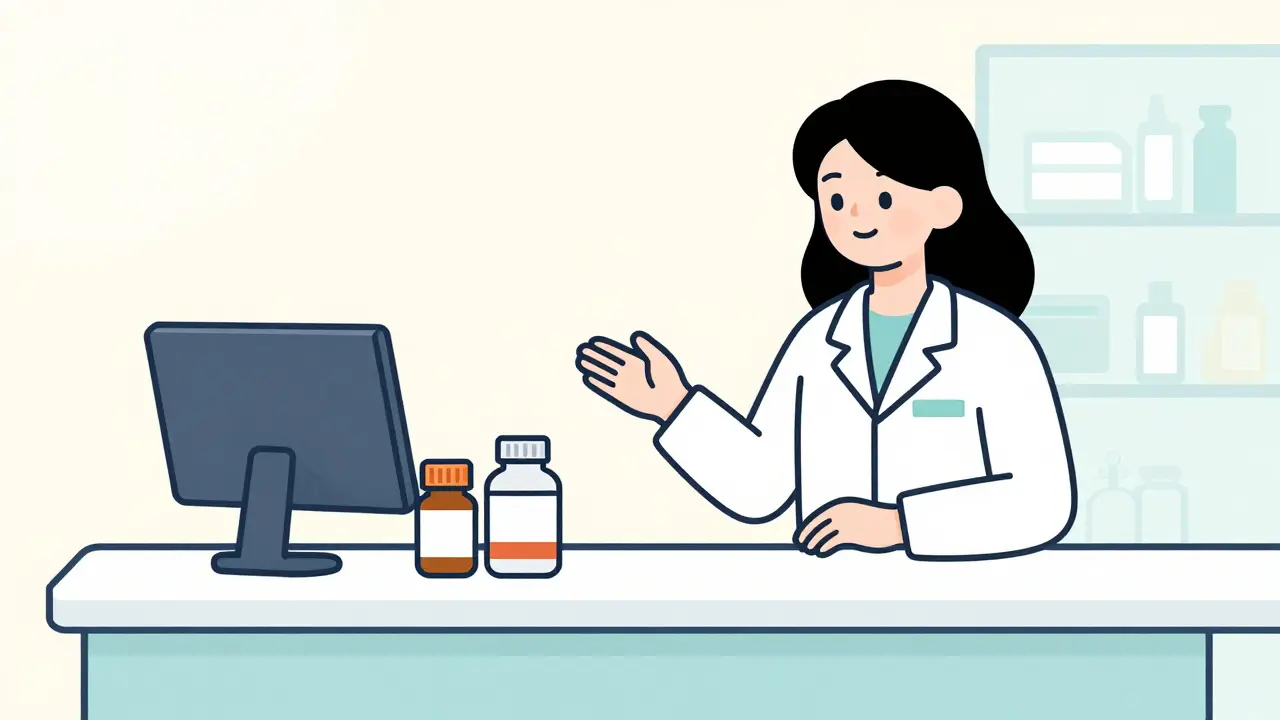
You've probably been at a pharmacy counter and had the pharmacist ask, "Do you want the generic version?" or simply handed you a bottle that looks different from the brand name your doctor wrote on the script. This isn't just a courtesy; it's the result of a complex web of generic substitution laws that vary wildly depending on which state you're standing in. Whether you're trying to save money on a monthly prescription or wondering why your pharmacist is suddenly asking for your explicit consent, understanding these rules helps you navigate the healthcare system without getting blindsided by costs or confusing paperwork.
At its core, the goal is simple: save you money by replacing an expensive brand-name drug with a cheaper, identical version. But the way we get there is a legal patchwork. Some states mandate that pharmacists swap the drug, while others just allow it. Some require your permission first, and others just notify you after the fact. If you live near a state border, you might even notice different pharmacy behaviors just a few miles apart.
The Basics: How Substitution Actually Works
Before we look at the state maps, we need to understand what makes a drug "substitutable." Pharmacists don't just guess; they rely on the FDA Orange Book is the official federal publication used to determine if a generic drug is therapeutically equivalent to a brand-name drug. If the Approved Drug Products with Therapeutic Equivalence Evaluations indicates that two drugs are the same in dosage, strength, and quality, they are considered interchangeable.
Historically, states had "anti-substitution laws" that forced pharmacists to give you exactly what the doctor wrote, even if it cost ten times more. That started to change in the late 70s and early 80s. Louisiana led the charge in 1980, and eventually, all 50 states adopted some version of drug product selection laws to lower costs for patients and insurance providers.
State-by-State Variations: Mandates vs. Permissions
Not all states treat these laws the same. In the pharmaceutical world, there is a big difference between "shall" and "may." In 19 states, including California, New York, and Texas, pharmacists are mandated to substitute a generic if one is available. In these states, the default is the cheaper option.
In 31 other states and DC, substitution is permissive. This means the pharmacist can switch the drug, but they aren't required to. This distinction matters because data shows that mandatory substitution states see generic use rates about 8-12% higher than permissive states. For the average patient, this can mean saving an extra $50 to $150 per prescription every year.
| Law Type | Pharmacist Action | Patient Impact | Example States |
|---|---|---|---|
| Mandatory ("Shall") | Must substitute if available | Highest generic utilization, lower costs | CA, NY, TX |
| Permissive ("May") | Can substitute if available | Variable utilization, potential for higher costs | AK, DE, ME, NH |
| Restrictive | Requires specific authority/consent | Lowest utilization, highest safety focus | OK, HI (for certain drugs) |
The "Consent" Hurdle: Who Needs to Say Yes?
Depending on where you live, the conversation at the pharmacy counter changes. In most states, the pharmacist just notifies you that a substitution happened. However, in seven states-including Connecticut, Maryland, and Vermont-as well as DC, the pharmacist must get your explicit consent before they can make the switch.
Why does this matter? It sounds like a small detail, but it's a significant barrier. Research published in the American Journal of Managed Care found that patients in "consent-required" states have about 12.7% lower utilization of generics. Essentially, if the process is a bit more tedious, fewer people end up with the cheaper drug, even if it's clinically identical.
High-Stakes Meds: Narrow Therapeutic Index (NTI) Drugs
Some drugs are too volatile for a "one size fits all" substitution rule. These are called Narrow Therapeutic Index (NTI) drugs. For these medications, a tiny difference in how the drug is absorbed can lead to a toxic overdose or a total failure of the treatment. Think of things like Warfarin (a blood thinner) or Levothyroxine (for thyroid issues).
Because of this risk, some states use "positive" or "negative" formularies. For example, Kentucky maintains a specific list of NTI drugs-including certain antiepileptic drugs-that cannot be substituted without extra caution. In Hawaii, you can't substitute antiepileptics unless both the doctor and the patient give the green light. This is why your pharmacist might suddenly seem very hesitant to switch a medication that they'd normally swap in a heartbeat.
The New Frontier: Biologics and Biosimilars
The rules for traditional pills (small-molecule drugs) are well-established, but "biologics"-complex proteins grown in living cells-are a different story. Biosimilars are the biologic equivalent of generics, but they aren't identical copies; they are "highly similar."
Because biologics are more complex, 45 states have much stricter rules for substituting them. In most cases, a biologic must be designated as "interchangeable" by the FDA under the Public Health Service Act before a pharmacist can touch it. Even in states that mandate generic swaps for pills, many (like Florida and New Jersey) only make biologic substitution permissive. This is a huge reason why biosimilars only make up a small fraction of the market compared to the 90% saturation of traditional generics.
The Pharmacist's Nightmare: Border Crossings and Liability
If you're a pharmacist working for a chain like Walgreens or CVS, the state-by-state breakdown is a daily headache. A pharmacist in a border town might have to switch their mental rulebook every time a patient from the neighboring state walks in. To handle this, many pharmacies now use the "State Substitution Rules Engine" within software like Epic Systems to automate the legal requirements based on the pharmacy's zip code.
Then there's the issue of liability. Who is responsible if a substituted drug causes a reaction? In 24 states, including Alabama and Massachusetts, there is no explicit law protecting pharmacists from liability when they perform a substitution. In these regions, you might find pharmacists being extra cautious-or even refusing to substitute-simply to avoid a potential lawsuit, which can ironically lead to patients paying more for brand names.
Looking Ahead: Is Standardization Coming?
The current chaos is expensive. The Congressional Budget Office projects that the lack of standardized laws will cost the US healthcare system billions of dollars annually because people continue to use expensive brand names when a generic would work perfectly. In response, 12 state legislatures recently introduced the "State Harmonization of Generic Substitution Act" to create a unified standard.
Recent data shows that when states simplify these laws-specifically by removing the need for patient consent for most drug classes-generic use jumps significantly. As we move toward 2027 and beyond, the trend is leaning toward more automation and less bureaucracy, though the tension between "cost-saving" and "patient safety" will always remain the central point of debate.
What is the difference between a generic and a biosimilar?
A generic is a chemically identical copy of a small-molecule drug. A biosimilar is a version of a biologic drug (made from living organisms) that is highly similar but not identical in structure. Because they are more complex, biosimilars have much stricter substitution laws and often require an FDA "interchangeable" designation before a pharmacist can swap them.
Can my doctor forbid a generic substitution?
Yes. Regardless of state law, a doctor can write "Dispense as Written" (DAW) on your prescription. This tells the pharmacist that the brand-name version is medically necessary and must not be substituted, even if a generic is available and cheaper.
Why do some states require my consent before switching to a generic?
Some states prioritize patient autonomy and safety over cost. By requiring explicit consent, these laws ensure the patient is fully aware of the change in medication, which is particularly important for those who may be sensitive to different inactive ingredients (fillers) in generic versions.
What is the FDA Orange Book and why does it matter?
The Orange Book is the gold standard for pharmaceutical equivalence. It lists which generic drugs are "therapeutically equivalent" to brand names. Pharmacists use this book (or its digital version) to ensure that a substitution is safe and effective before dispensing it to a patient.
Are there drugs that should never be substituted?
Drugs with a Narrow Therapeutic Index (NTI), such as certain blood thinners or seizure medications, are high-risk. Small variations in the generic version can cause the drug to either not work or become toxic. In many states, these drugs have special protections or prohibitions against automatic substitution.
Next Steps & Troubleshooting
If you are a patient: If you're in a permissive state and your pharmacist doesn't offer a generic, don't be afraid to ask for one. Check the FDA Orange Book app to see if a therapeutic equivalent exists. If you're on an NTI drug, talk to your doctor before switching generics, as staying on the same manufacturer can prevent "stability swings."
If you are a pharmacy professional: If you practice across state lines, rely on updated tools like the National Association of Boards of Pharmacy's interactive map. Ensure your pharmacy management software is updated to the latest state-specific rules engine to minimize liability and errors.


Joel Bonstell
May 1, 2026 AT 16:50