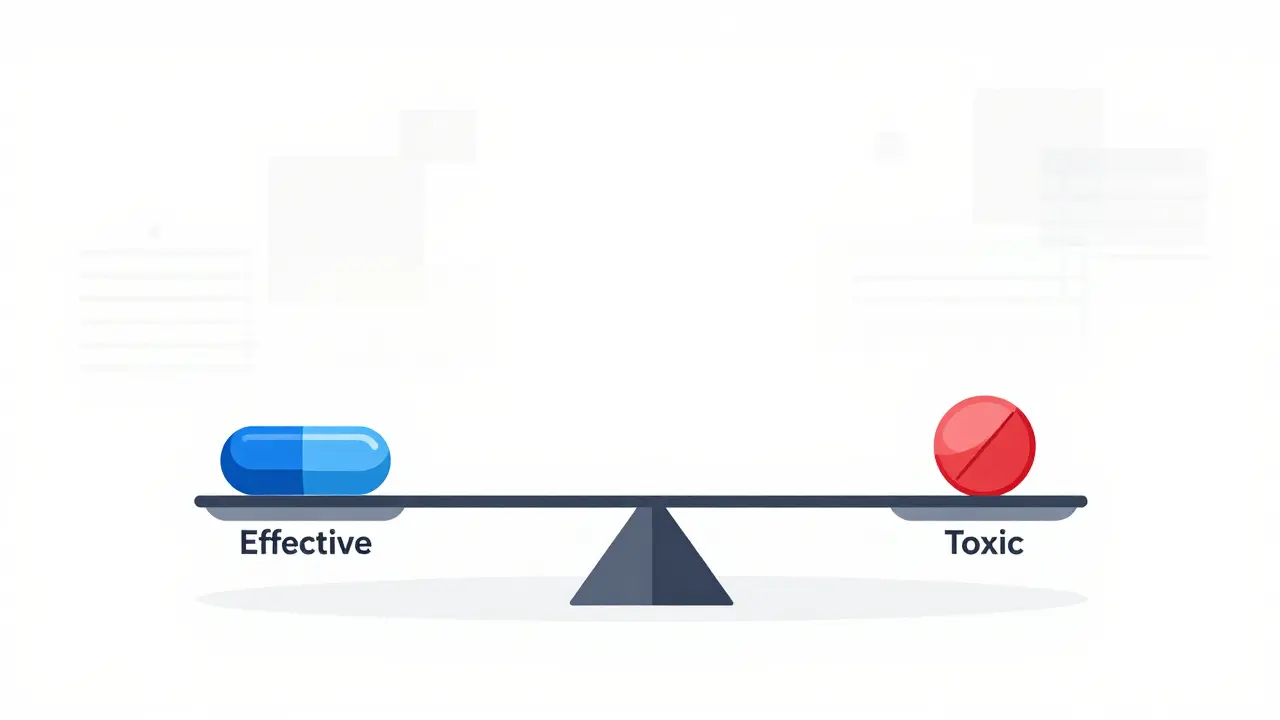
Imagine taking a medication where a tiny change in dose could mean the difference between healing and hospitalization. This is the reality for patients on Narrow Therapeutic Index (NTI) drugs, which are medications where small differences in blood concentration can lead to serious therapeutic failures or adverse reactions. For these critical medicines, the standard rules for approving generics don't cut it. The U.S. Food and Drug Administration (FDA) has established much stricter bioequivalence standards to ensure that generic versions of NTI drugs are truly interchangeable with their brand-name counterparts.
What Makes an NTI Drug Different?
Not all medications are created equal when it comes to safety margins. Most drugs have a wide window between the dose that works and the dose that causes harm. But for NTI drugs, that window is razor-thin. The FDA formally defines NTI drugs as those where small variations in dose or blood levels may lead to serious issues. In 2022, the agency published pharmacometric research establishing that a therapeutic index of ≤ 3 is a reasonable cutoff for this classification. This means if the ratio between the toxic dose and the effective dose is three or less, the drug likely falls into the NTI category.
Why does this matter? Because a 20% difference in drug exposure-which might be acceptable for a painkiller-could be unacceptable for an immunosuppressant or an anticoagulant. Common examples of NTI drugs include warfarin (a blood thinner), phenytoin (an antiepileptic), carbamazepine, digoxin, and tacrolimus. These medications often require routine therapeutic monitoring because their doses are adjusted in small increments, sometimes less than 20%.
The Shift from Standard to Stricter Bioequivalence Limits
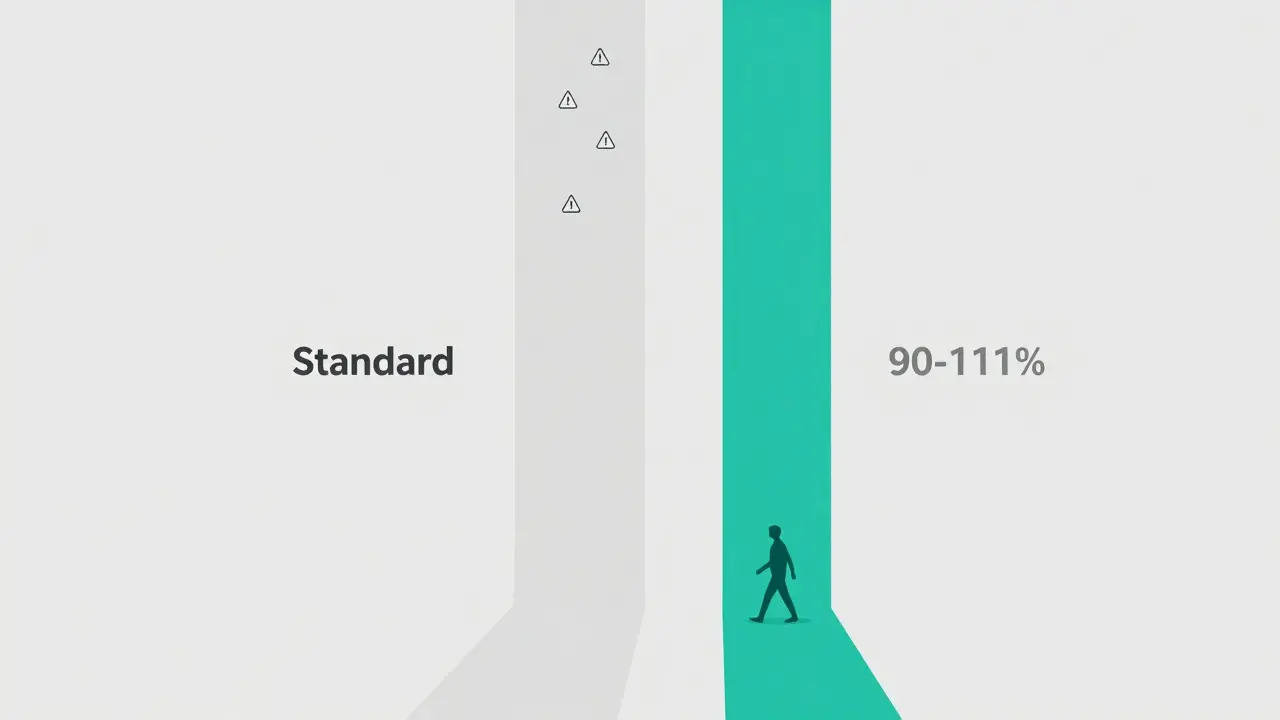
For most generic drugs, the FDA uses a standard bioequivalence range of 80.00% to 125.00%. This means the generic must deliver between 80% and 125% of the active ingredient compared to the brand-name reference product. However, back in April 2010, the Advisory Committee for Pharmaceutical Science and Clinical Pharmacology voted 11-2 that these limits were too loose for NTI drugs. They recommended narrowing the confidence intervals to 90-111%.
Today, the FDA applies a dual-criteria approach for NTI drugs. A generic NTI drug must pass both the reference-scaled limits and the unscaled average bioequivalence limits. Specifically, the acceptance interval is tightened to 90.00-111.11%. Additionally, the upper limit of the 90% confidence interval of the ratio of within-subject standard deviation of the test to reference product must be ≤ 2.5. This ensures that not only is the average effect similar, but the variability is also tightly controlled.
| Parameter | Standard Generic Drugs | NTI Drugs |
|---|---|---|
| Bioequivalence Range | 80.00 - 125.00% | 90.00 - 111.11% |
| Quality Assay Acceptance | 90 - 110% | 95 - 105% |
| Variability Constraint | None specific | Upper limit of CI of WSV ratio ≤ 2.5 |
| Study Design | Crossover typically sufficient | Replicate studies often required |
Tighter Quality Controls Beyond Bioavailability
Bioequivalence isn't just about how much drug gets into your bloodstream; it's also about the quality of the pill itself. For NTI drugs, the FDA tightens the quality assay acceptance range to 95-105 percent. Compare this to the 90-110 percent allowed for non-NTI drugs. This means the manufacturing process for generic NTI drugs must be incredibly precise. Even slight deviations in the amount of active pharmaceutical ingredient (API) per tablet can push a patient out of their therapeutic window.
This precision extends to the study designs themselves. The FDA mandates that bioequivalence studies for NTI drugs often include replicate studies. These are more complex than standard crossover studies because they allow regulators to estimate within-subject variability more accurately. Larger sample sizes are frequently required to demonstrate equivalence within the tighter 90-111% range with statistical power. The goal is to ensure that the generic product behaves predictably in every individual patient, not just on average across a group.
How the FDA Identifies NTI Drugs
You might expect to find a simple list of NTI drugs on the FDA website, but you won't. Instead, the FDA identifies NTI status through product-specific guidance documents. This case-by-case approach allows the agency to consider unique pharmacokinetic properties of each drug. To qualify for NTI designation, a drug generally meets several criteria: a maximum 2-fold difference between minimum effective and minimum toxic dose, a requirement for routine therapeutic monitoring, low-to-moderate within-subject variability (≤ 30%), and doses that are often adjusted in small increments.
In 2022, the FDA moved toward more objective classification by adopting a pharmacometric approach. They determined that a therapeutic index ≤ 3 is a reasonable quantitative criterion. Evidence showed that 10 out of 13 analyzed NTI drugs had a therapeutic index ≤ 3, while three had indices between 3 and 5. This data-driven shift helps reduce ambiguity and ensures that drugs like everolimus and valproic acid are correctly categorized based on scientific evidence rather than just historical precedent.
Addressing Clinician Concerns and Real-World Evidence
Despite these strict standards, some clinicians and patients remain hesitant about switching to generic NTI drugs. This is particularly true for antiepileptics, where conflicting literature has raised doubts about therapeutic equivalence. Dr. Honghui Zhou, Director of the FDA’s Office of Generic Drugs, emphasizes that generic NTI drugs are approved as clinically substitutable with their brand-name versions. He notes that real-world evidence reflects the therapeutic equivalence of these products when manufactured under FDA standards.
However, the FDA acknowledges the need for better education among pharmacists and physicians. Some states still maintain affirmative patient consent requirements or prohibit automatic substitution for NTI drugs, creating a patchwork of regulations. The FDA argues that eliminating these unnecessary barriers would increase access to affordable generic NTI drugs without compromising safety. As of 2022, approximately 15% of newly approved generic drugs involved NTI medications, highlighting the growing importance of these specialized standards.
Global Harmonization and Future Directions
The FDA’s approach to NTI drugs differs slightly from other major regulatory bodies like Health Canada and the European Medicines Agency (EMA). While Health Canada and EMA primarily recommend direct tightening of average bioequivalence limits, the FDA employs a nuanced scaled approach based on the reference product’s variability. This Reference Scaled Average Bioequivalence (RSABE) method allows for flexibility depending on how variable the original brand-name drug is in the population.
Looking ahead, the FDA has identified further harmonization of NTI drug classification and bioequivalence approaches among global regulatory agencies as a priority. Ongoing research focuses on expanding the evidence base for NTI drug interchangeability, with tacrolimus and warfarin serving as model drugs for study. The agency continues to refine its pharmacometric tools to ensure that the standards remain scientifically robust while facilitating patient access to safe, effective generic alternatives.
What is the primary bioequivalence range for NTI drugs according to the FDA?
The FDA requires a tighter bioequivalence range of 90.00% to 111.11% for NTI drugs, compared to the standard 80.00% to 125.00% range used for most other generic medications. This narrower window ensures that small variations in drug absorption do not compromise patient safety.
Does the FDA publish a complete list of Narrow Therapeutic Index drugs?
No, the FDA does not maintain a single comprehensive public list of NTI drugs. Instead, NTI status is identified through product-specific guidance documents. You can determine if a drug is considered NTI by reviewing the specific guidance issued for that particular medication by the FDA.
Why are quality assay limits stricter for NTI drugs?
Quality assay limits for NTI drugs are tightened to 95-105% (versus 90-110% for standard drugs) because even minor deviations in the amount of active ingredient per tablet can lead to significant clinical consequences. Given the narrow margin between therapeutic and toxic doses, precise manufacturing is critical.
Are generic NTI drugs considered safe substitutes for brand-name versions?
Yes, the FDA approves generic NTI drugs as therapeutically equivalent to their brand-name counterparts when they meet the stricter bioequivalence and quality standards. Real-world evidence supports their safety and efficacy, although some clinicians may still prefer brand names due to historical concerns or state-level substitution policies.
What is the therapeutic index cutoff for defining an NTI drug?
In 2022, the FDA established that a therapeutic index ≤ 3 is a reasonable quantitative cutoff for defining NTI drugs. This metric represents the ratio between the toxic dose and the effective dose, indicating how narrow the safety margin is for the medication.


Brett Aungst
July 4, 2026 AT 12:33