
Complex Regional Pain Syndrome (CRPS) isn’t just a sore limb-it’s your brain misfiring. After an injury, surgery, or even a minor bump, the pain doesn’t fade. Instead, it grows. Your skin feels like it’s on fire from a light touch. Your hand swells for no clear reason. Moving feels impossible, not because your muscles are weak, but because your brain thinks every movement is a threat. This isn’t in your head-it’s in your nervous system. And the good news? There’s a proven way to retrain it: desensitization and graded motor imagery.
What CRPS Really Does to Your Brain
< p>CRPS doesn’t start as a brain problem. It begins with an injury-broken bone, sprain, burn, or even a needle stick. But instead of healing, the pain signals get stuck. Your nerves become hypersensitive. Then your brain starts to change. The area that maps your hand or foot in your somatosensory cortex begins to blur. Neighboring areas invade it. This is called cortical smudging. Your brain forgets what your limb looks like, how it moves, and what normal touch feels like. It starts treating your own body like an enemy.That’s why a feather hurts. Why your skin turns red and cold. Why you can’t wear socks or hold a coffee cup. Your nervous system is screaming danger-even when there’s none. Traditional painkillers? They rarely help. This isn’t inflammation. It’s a neurological glitch. And fixing it requires rewiring, not just masking.
Desensitization: Teaching Your Skin to Stop Screaming
Desensitization therapy is like exposure therapy for your skin. You don’t avoid touch-you slowly, safely reintroduce it. The goal? To teach your brain that light pressure isn’t a threat.
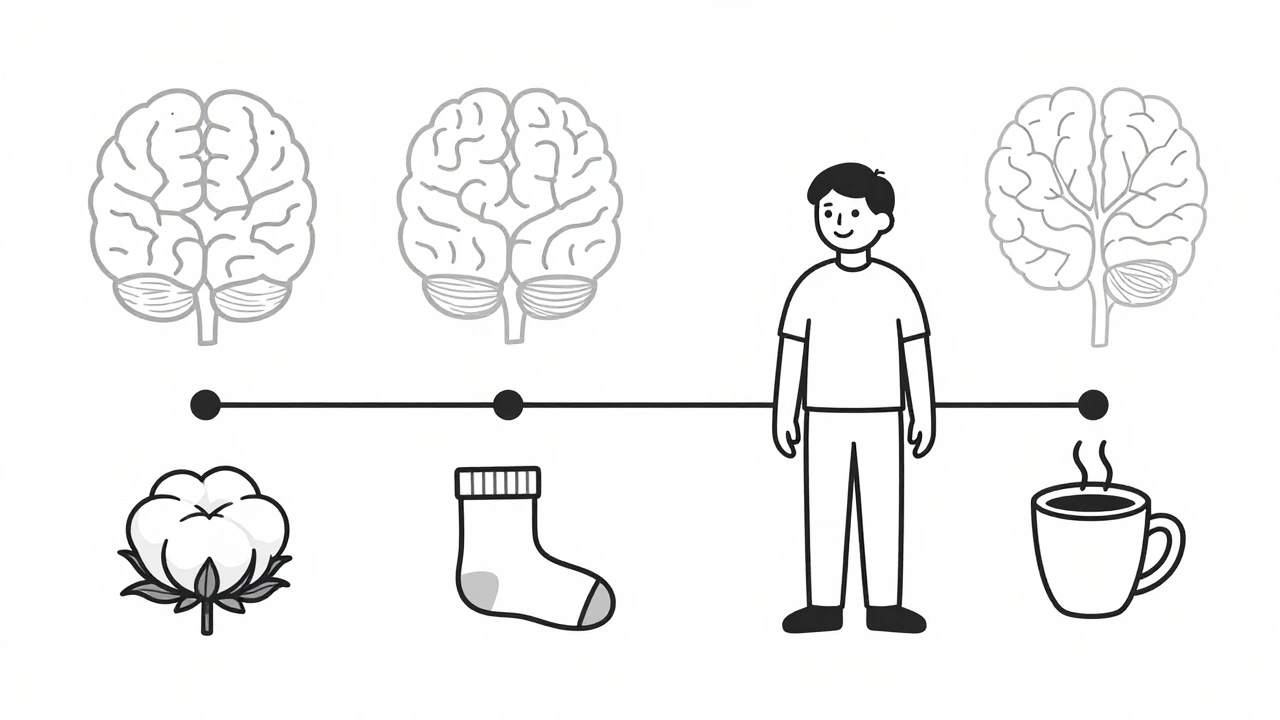
It starts with something barely there: a cotton ball. You touch your painful hand with it for five minutes, three to five times a day. No painkiller. No pushing through. Just gentle contact. If your pain stays under 3 out of 10, you move to the next texture-silk, then velvet, then a soft towel. After a few weeks, you might try denim, then sandpaper. Eventually, you’re putting on a shirt without flinching.
This isn’t magic. It’s neuroscience. Studies using fMRI show that after eight weeks of consistent desensitization, the brain’s pain response drops by 30-40%. The overactive neurons in your spinal cord calm down. Glial cells, which were firing alarms nonstop, quiet down too. A 2021 trial with 127 CRPS patients found those doing desensitization improved 42% more on hand function tests than those who didn’t.
There are four phases:
- Phase 1 (0-2 weeks): Light touch with eyes open. Cotton, silk. No movement.
- Phase 2 (2-4 weeks): Add gentle movement while touching-wiggle fingers, rotate wrist.
- Phase 3 (4-8 weeks): Introduce temperature. Cool washcloth, then warm.
- Phase 4 (8+ weeks): Normal clothing, daily activities. No more therapy-just living.
Progression is slow. Some patients take 47 days just to get from cotton to normal socks. But sticking with it? That’s what separates recovery from chronic suffering.
Graded Motor Imagery: Rewiring Your Brain Without Moving
Graded Motor Imagery (GMI) is the most powerful tool we have for CRPS. It doesn’t require strength. It doesn’t require pain. It only requires your mind.
Developed by Dr. G. Lorimer Moseley in the early 2000s, GMI has three stages. Each one targets a different part of the brain’s faulty pain map.
Stage 1: Left-Right Discrimination
You look at pictures of hands or feet-some left, some right. Your job? Say which is which. Fast. No thinking. Just instinct. You start with 50 images a day. If you get 90% right in under 1.5 seconds per image, you move to 200. Apps like Recognise Online make this easy. This stage rebuilds your brain’s sense of body ownership. In CRPS, your brain can’t tell left from right anymore. That’s why you feel disconnected from your own limb.
Stage 2: Explicit Motor Imagery
Now you imagine moving your limb-without moving it. Picture yourself picking up a cup. Turning a doorknob. Typing on a keyboard. Do it for 5-10 minutes a day. No pain. No strain. Just mental rehearsal. Your brain doesn’t know the difference between imagining a movement and doing it. This reactivates the motor cortex without triggering pain signals.
Stage 3: Mirror Therapy
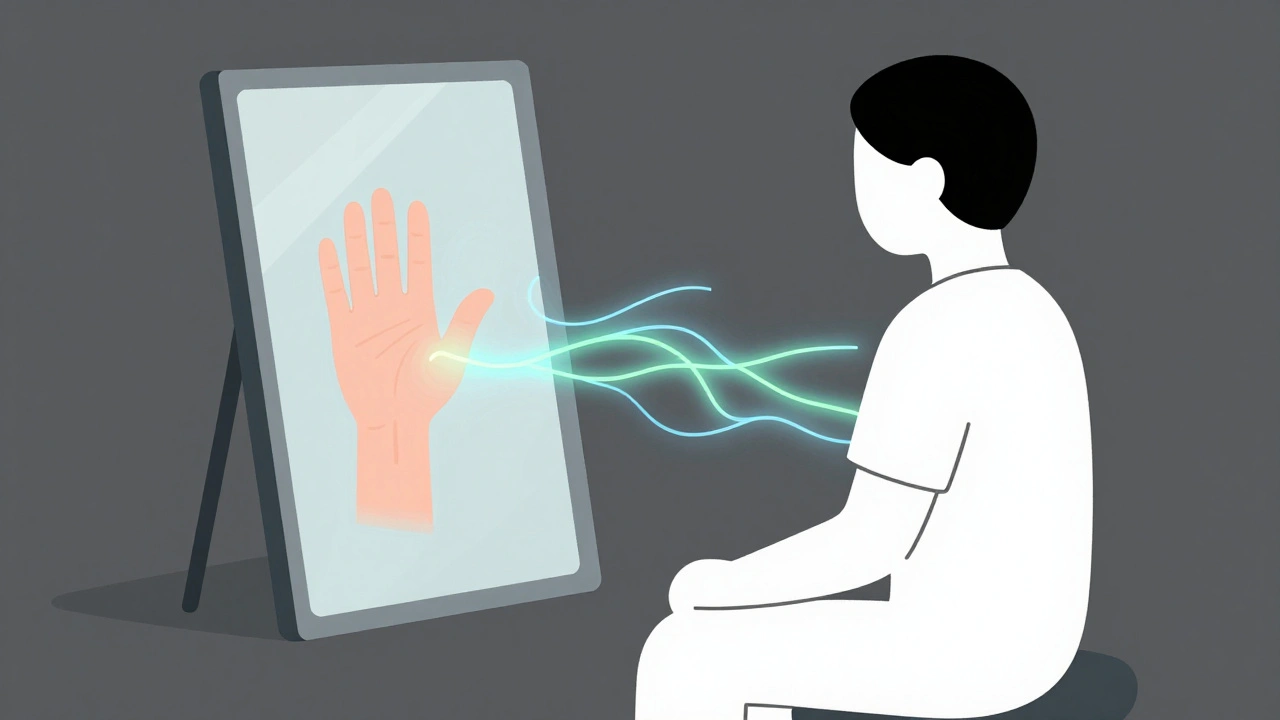
You set up a mirror so it reflects your healthy hand as if it’s your painful one. You move your healthy hand-opening and closing it, waving it. Your brain sees the reflection and thinks the painful hand is moving normally. This tricks your brain into believing the limb is safe. Sessions start at 5 minutes, build to 20-30 minutes daily over 6-12 weeks.
The results? In Dr. Moseley’s 2006 study, 70% of patients had 50% less pain after just four weeks. fMRI scans showed their brain maps returning to normal. A 2023 review of 33 trials found GMI reduced pain 2.8 points more on a 10-point scale than traditional therapy. That’s huge.
Why GMI Beats Traditional Physical Therapy
Traditional rehab for CRPS often focuses on stretching, strengthening, and range-of-motion exercises. Sounds logical, right? But here’s the problem: when your brain is terrified of movement, forcing it makes things worse. You get pain spikes. You lose motivation. You quit.
GMI works differently. It doesn’t force movement. It rebuilds the brain’s confidence in movement first. Only then do you add physical activity. That’s why studies show GMI leads to 40% greater improvement in upper limb function than conventional therapy alone.
And when you combine GMI with desensitization and cognitive behavioral therapy? That’s when you see the biggest gains. One 2022 study showed a 5.2-point drop in pain on a 10-point scale after 24 weeks-nearly half the pain gone.
Who Shouldn’t Try This-and Why
GMI and desensitization work for most people. But not all.
If you have severe cognitive impairment-like an MMSE score below 24-you may struggle with the discrimination tasks. If you have major vision problems, mirror therapy won’t work. And if you try to rush it? You’ll make things worse.
One in six patients experience symptom flare-ups when GMI is pushed too fast. That’s why it’s critical to work with a therapist trained in CRPS. The American Physical Therapy Association says therapists need at least 40 hours of specialized training. Without it, you risk making your pain worse.
And yes, it’s hard. Reddit user PainWarrior2020 said: “The first two weeks were brutal. My pain spiked 30%.” But they kept going. By week six, they picked up a coffee cup for the first time in 18 months.
Getting Started: What You Need to Know
If you’re considering this, here’s what works:
- Start early. If you begin within three months of symptoms, success rates jump to 83%. After 12 months? It drops to 42%.
- Use certified tools. The NOI Group’s GMI protocol and Hand Therapy Certification Commission (HTCC) standards are gold.
- Track your pain. Use a 0-10 scale daily. Only progress when pain stays below 3 during and after sessions.
- Combine therapies. GMI + desensitization + psychological support = best results.
Apps like Miro Therapeutics, cleared by the FDA in 2022, now guide patients through GMI at home. In a 2023 study, users stuck with it 35% longer than those using paper flashcards.
And the access gap? Real. Only 42% of rural clinics in the U.S. have therapists trained in these techniques. That’s why telehealth is growing fast-67% effective in bringing expert care to remote areas.
Real People, Real Results
On the CRPS Patient Foundation’s 2023 survey of 1,200 people:
- 68% had meaningful pain reduction with GMI.
- 42% cut their pain by more than half after six months.
- 79% stuck with desensitization-even though it took weeks to feel progress.
One woman from New Zealand shared: “After three months of GMI, my hand warmed up from 82°F to 96°F. I could wear socks again. I cried.”
Another man from Texas said: “I thought I’d be in pain forever. Now I’m gardening again. Not because I’m strong. Because my brain finally believes it’s safe.”
The Bottom Line
CRPS isn’t a life sentence. It’s a misfiring system-and systems can be reprogrammed. Desensitization teaches your skin it’s not under attack. Graded Motor Imagery teaches your brain it’s safe to move. Together, they don’t just reduce pain. They restore function. Identity. Control.
You don’t need surgery. You don’t need opioids. You need time. Patience. And the right protocol.
It’s not easy. But it’s worth it.


Jaswinder Singh
December 1, 2025 AT 14:32