What COPD Stages Actually Tell You
When your doctor says you have COPD, they don’t just mean you’re out of breath. They’re telling you where you are on a clear, measurable path - and that path has four stages. Most people only hear "mild," "moderate," or "severe" - but what do those labels really mean for your daily life, your treatment, and your future?
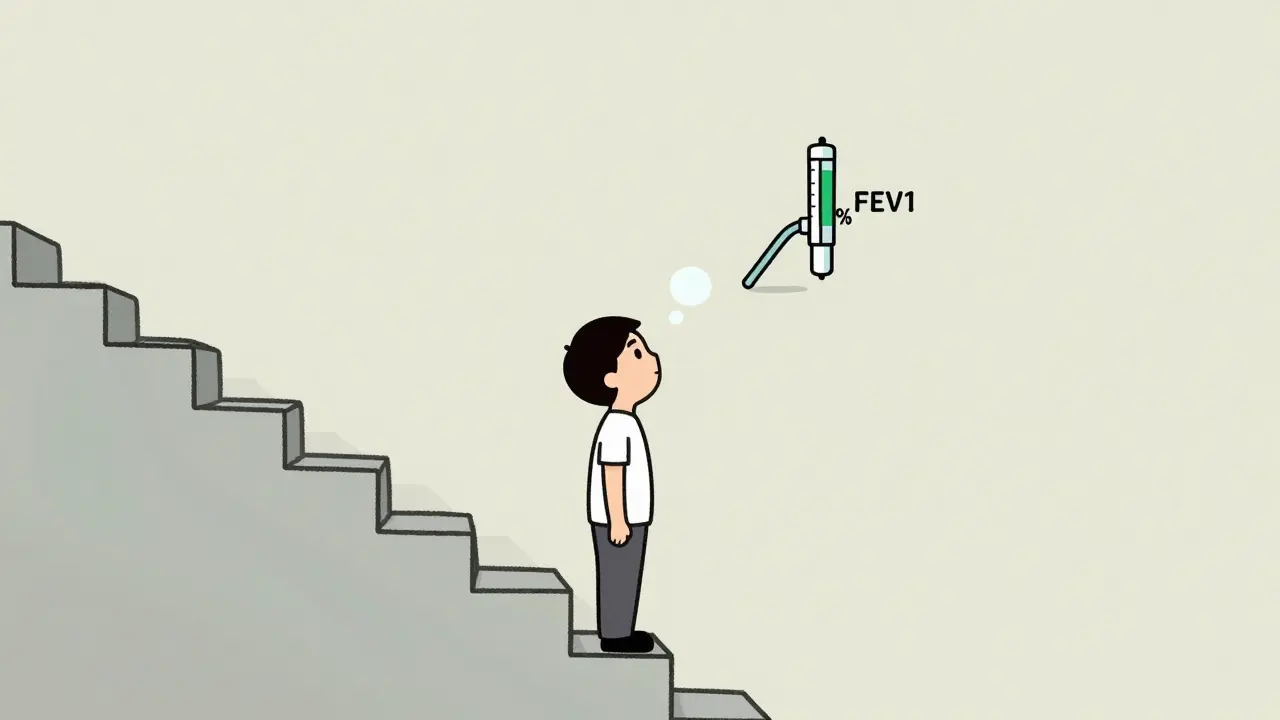
The answer isn’t guesswork. It’s based on a test called spirometry. You breathe into a tube, and the machine measures how much air you can force out in one second - that’s your FEV1. This number, compared to what’s normal for someone your age, height, and sex, tells your doctor your stage. It’s not about how you feel. It’s about hard numbers. And those numbers guide every decision from your inhaler to whether you need oxygen at home.
Stage 1: Mild COPD - The Silent Progression
Stage 1 COPD means your FEV1 is 80% or higher of what it should be. Sounds fine, right? But here’s the catch: you might not even know you have it. Many people brush off early symptoms as "just getting older" or "not being fit." You might notice you get winded climbing stairs faster than you used to, or you’ve developed a persistent morning cough with phlegm. You think it’s because you’re 55, not because your lungs are changing.
Here’s what’s happening inside: your airways are slowly narrowing. The tiny air sacs in your lungs are losing elasticity. But your body is good at adapting - you slow down, avoid stairs, skip long walks. You don’t realize you’re limiting yourself. A 2021 study found that 65% of people in Stage 1 only feel short of breath when walking fast or climbing hills. That’s not "normal aging." It’s early COPD.
And here’s the good news: this is the best time to act. Quitting smoking right now can cut the rate of lung decline in half. The Lung Health Study showed smokers who quit dropped their FEV1 loss from 60 mL per year to just 30 mL. That’s not just slowing the disease - it’s changing your trajectory. Pulmonary rehab, even at this stage, can improve your stamina and confidence. One patient diagnosed in 2021 with an FEV1 of 85% told an online forum: "Quitting smoking at Stage 1 has kept my FEV1 stable for two years. My doctor says I might avoid progression entirely."
Stage 2: Moderate COPD - The Breaking Point
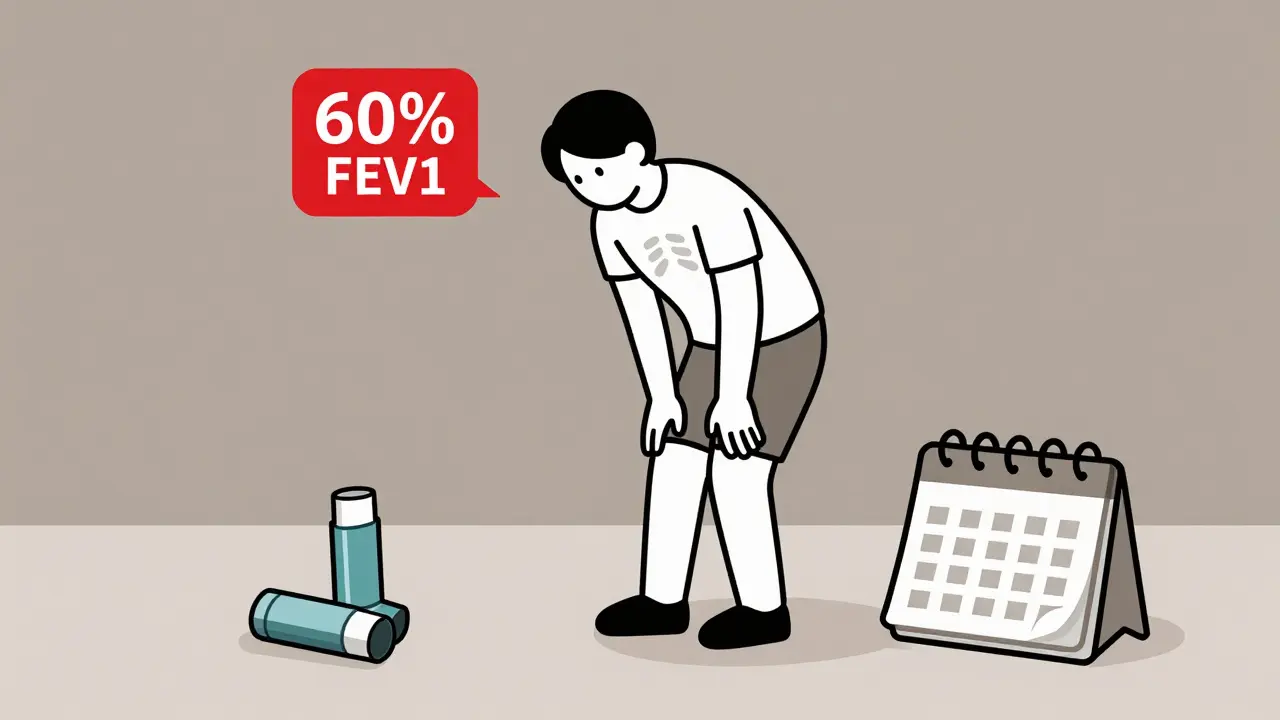
Now your FEV1 is between 50% and 79%. This is where things start to feel real. You’re not just out of breath on hills - you’re stopping every few minutes on flat ground. You’re coughing more. Your clothes feel tighter because you’re using your chest muscles just to breathe. You might skip social events because walking to the car leaves you exhausted.
Eighty-three percent of Stage 2 patients report having to pause while walking on level ground. Seventy-six percent say mucus production is interfering with daily tasks. This isn’t "getting winded." This is your lungs working harder just to keep up. And it’s often when people finally go to the doctor - after years of ignoring it. The CDC says the average delay in diagnosis is 5.2 years. That’s over half a decade of avoidable damage.
Treatment shifts here. You’ll likely start on a long-acting inhaler - either LABA or LAMA - which can improve your FEV1 by 100-150 mL on average. Pulmonary rehab becomes essential. Studies show it adds 45 to 75 meters to your 6-minute walk distance. That’s not just a number - it’s the difference between needing help to shower and doing it yourself. Annual flu shots aren’t optional anymore. They cut your risk of flare-ups by 32%.
But here’s the twist: your stage doesn’t always match how you feel. About 38% of people classified as "high risk" (GOLD Group D) based on symptoms and flare-ups actually have Stage 2 COPD. That means your doctor might treat you like you’re in Stage 3, even if your FEV1 says otherwise. Your symptoms matter as much as your numbers.
Stage 3: Severe COPD - The Daily Battle
At this stage, your FEV1 drops to 30-49%. You’re not just slow - you’re limited. Ninety-two percent of patients here say they get out of breath just getting dressed or washing up. Sixty-eight percent have low oxygen levels during normal activities. You might need to sit down to make coffee. You might stop going out because even a short walk feels like climbing a mountain.
Treatment gets more aggressive. You’ll likely be on a combination inhaler - LAMA and LABA together - which reduces moderate to severe flare-ups by 14%. If your blood test shows high eosinophils (over 300 cells/μL), you may add an inhaled steroid. That cuts flare-ups by another 25%. You’ll be monitored closely for exacerbations - hospital visits are now a real threat. Each one carries a 22% risk of death within a year.
Patients on online forums describe panic attacks triggered by simple tasks. One Reddit user wrote: "I can’t walk to my mailbox (20 feet) without stopping to breathe - my FEV1 is 38%, but my doctors keep saying I’m ‘only’ Stage 3, so I must be exaggerating." That’s the cruel gap between numbers and lived experience. Your FEV1 doesn’t capture your fear, your fatigue, your isolation.
And it’s not just your lungs. A 2023 study in The Lancet found that 65% of Stage 2 and 3 COPD patients also have heart problems - high blood pressure, irregular rhythms, heart failure. These aren’t side effects. They’re part of the disease. Your lungs and heart are connected. Ignoring one hurts the other.
Stage 4: Very Severe COPD - Life on Oxygen
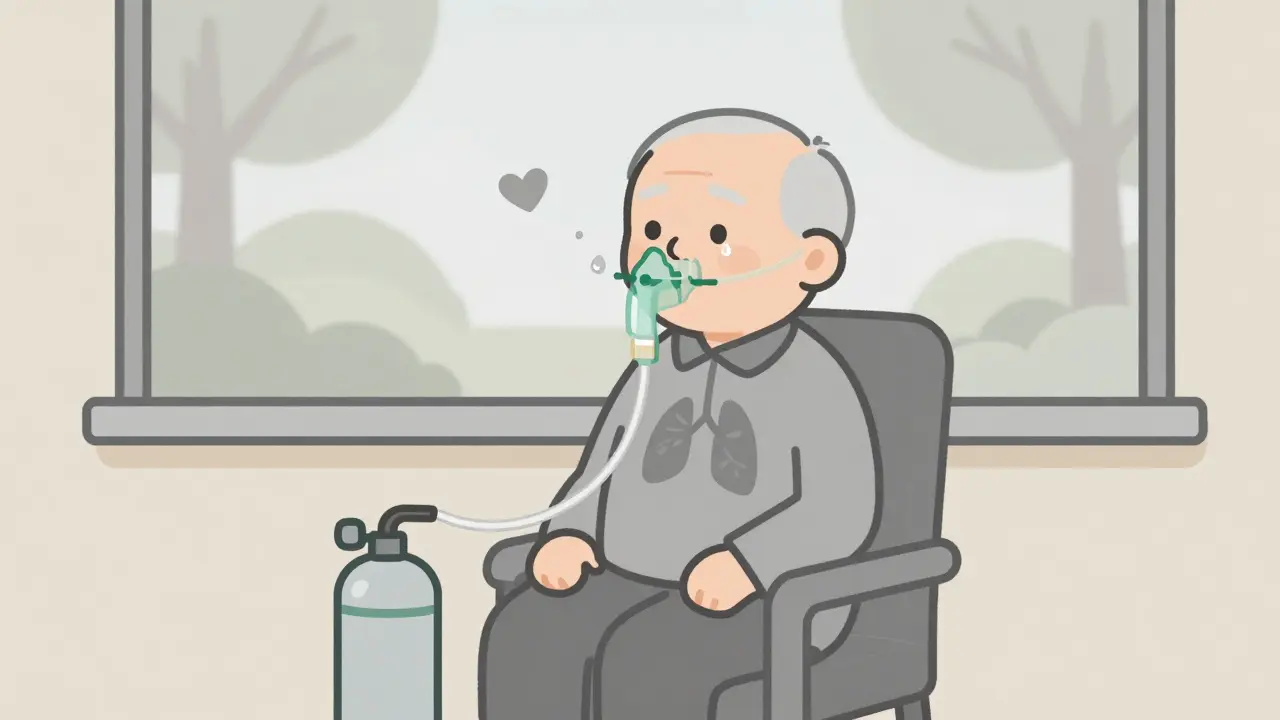
Your FEV1 is below 30%. This is the most advanced stage. Eighty-nine percent of people here need oxygen therapy for 15 hours or more every day. You’re not just breathing hard - you’re breathing with help. Your world shrinks to your home, your chair, your oxygen tank. Simple tasks like showering or answering the door become exhausting or impossible.
Non-invasive ventilation (a mask that helps you breathe) is often added. It reduces hospital readmissions by 28%. Long-term oxygen therapy doesn’t just make you more comfortable - it saves your life. The NOTT trial showed it increases one-year survival from 73% to 90%. That’s a 17-point jump. That’s the difference between watching your grandkids grow up and not.
But the cost is heavy. In the U.S., oxygen equipment costs $287 a month out-of-pocket, even with Medicare. Forty-four percent of Stage 4 patients report social isolation as their biggest struggle. They stop seeing friends because they can’t leave the house. They feel like a burden. They feel invisible.
And here’s the harsh truth: this stage isn’t just about lungs. It’s about survival. Every flare-up is life-threatening. Every infection could be the last. You’re not just managing COPD - you’re managing the risk of dying from it.
Why the Numbers Alone Don’t Tell the Whole Story
The GOLD staging system is powerful. It’s based on decades of research and global consensus. But it’s not perfect. It doesn’t measure how tired you are. It doesn’t measure your anxiety. It doesn’t measure how much you miss walking in the park or playing with your dog.
That’s why doctors now use a second tool - the ABCD assessment. It looks at your symptoms (using the CAT score or mMRC scale) and your history of flare-ups. Two people with the same FEV1 can be in completely different groups. One might have mild symptoms and no flare-ups (Group A). The other might have the same FEV1 but constant breathlessness and three hospital visits last year (Group D). They get different treatments.
And that’s the point. Your treatment should match your life - not just your test result.
What You Can Do Right Now
If you’ve been told you have COPD - no matter the stage - here’s what matters most:
- Quit smoking. It’s the single most effective thing you can do - even if you’ve smoked for 40 years.
- Get tested. If you’re over 40, a smoker or ex-smoker, and have breathlessness or cough, ask for spirometry. Only 12% of eligible people get it.
- Do pulmonary rehab. It’s not just exercise. It’s education, breathing techniques, and support. It works at every stage.
- Get your vaccines. Flu, pneumonia, and COVID-19 shots aren’t suggestions - they’re lifesavers.
- Know your triggers. Cold air, pollution, smoke, dust - avoid them when you can.
- Track your symptoms. Keep a journal. Note when you get breathless, when you cough more, when you feel worse. That’s data your doctor needs.
What’s Next for COPD
Research is moving fast. Scientists are testing blood tests that can predict how fast your lungs will decline. AI is being trained to read spirometry results more accurately than humans. New drugs are targeting inflammation at a molecular level. But none of this matters if we don’t catch COPD early.
Right now, the WHO warns that without better early detection, global COPD deaths will rise by 30% by 2030. Most of those deaths will happen in places with little access to spirometry. But even in places like New Zealand or the U.S., most people are still being diagnosed too late.
You don’t have to wait until you’re Stage 3 to act. The earlier you start, the more of your life you keep.


Lisa Rodriguez
February 1, 2026 AT 04:52