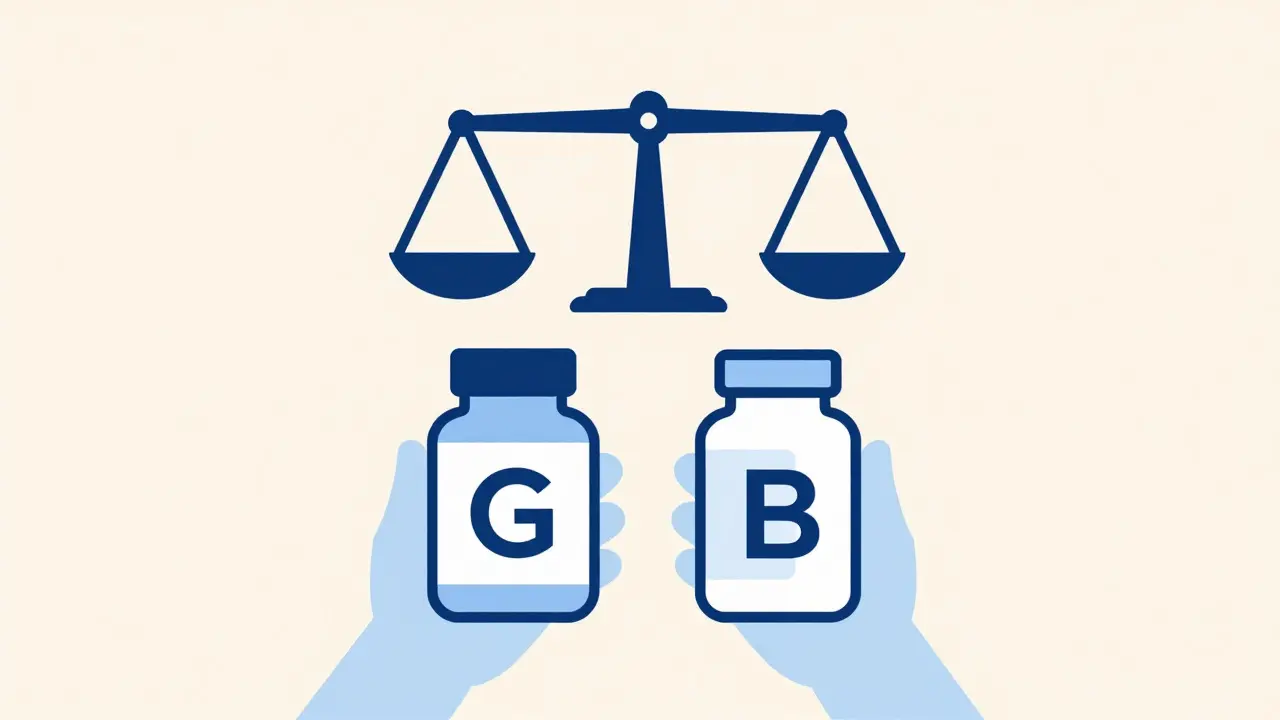
Imagine you switch from a brand-name medication to its generic counterpart. You expect the same relief, the same safety, and the same results. But how do we know for sure that the pill in your hand works exactly like the original? The answer lies in bioequivalence, a rigorous scientific standard enforced by the U.S. Food and Drug Administration (FDA). It is not just about having the same active ingredient; it is about proving that your body absorbs and processes the drug in nearly identical ways. Without this proof, a generic drug cannot legally replace the reference product on the market.
For many patients, "generic" implies a cheaper version of the same thing. For regulators and scientists, it means a complex statistical and physiological challenge. The FDA requires manufacturers to demonstrate that the rate and extent of absorption of the generic drug match the brand-name reference listed drug (RLD) within specific limits. This article breaks down what bioequivalence actually means, how the FDA measures it, and why the rules are stricter than most people realize.
What Is Bioequivalence?
Bioequivalence is the absence of a significant difference in the rate and extent to which the active ingredient in pharmaceutical equivalents becomes available at the site of drug action when administered at the same molar dose under similar conditions. This definition comes directly from federal regulations, specifically 21 CFR § 320.1. In simpler terms, if you take the generic and the brand-name drug, your blood levels of the medicine should rise and fall at almost the same speed and reach almost the same height.
This concept was born out of the Hatch-Waxman Act of 1984. Before this law, creating a new drug required years of expensive clinical trials to prove safety and efficacy. The Act created a shortcut called the Abbreviated New Drug Application (ANDA). If a company can prove their new product is bioequivalent to an existing approved drug, they don't have to repeat all those costly human trials. They rely on the data already collected for the brand-name drug. This efficiency is why generics account for roughly 90% of prescriptions filled in the United States today, saving the healthcare system billions of dollars annually.
The Science Behind the Comparison
To prove bioequivalence, researchers conduct randomized crossover studies. Typically, these involve 24 to 36 healthy volunteers. Each participant receives both the generic and the brand-name drug at different times, with a washout period in between to clear the first drug from their system. Scientists then measure two key pharmacokinetic parameters:
- Cmax (Peak Concentration): The highest level of the drug in the blood. This tells us how fast the drug is absorbed.
- AUC (Area Under the Curve): A calculation representing the total exposure to the drug over time. This tells us how much of the drug the body ultimately processes.
These measurements aren't just single data points. They are part of a statistical analysis designed to account for natural variation between individuals. The goal is to show that the average response of the group taking the generic is statistically indistinguishable from the group taking the brand-name product, within a predefined margin of error.

The 80-125% Rule: Misconceptions vs. Reality
Here is where confusion often sets in. Many people hear that generics must be "80% to 125% as effective" as brands and assume this means the generic could contain significantly less or more active ingredient. That is not how it works. The 80-125% range applies to the ratio of the geometric means of the pharmacokinetic parameters (Cmax and AUC), not the raw amount of drug in the tablet.
The FDA requires that the 90% confidence interval (CI) of the ratio of the generic to the reference drug falls entirely within the 80% to 125% range. Let's look at a concrete example to see why this is stricter than it sounds:
| Scenario | Mean Ratio (Generic/Brand) | 90% Confidence Interval | FDA Limit (80-125%) | Result |
|---|---|---|---|---|
| Passing Example | 93% | 84% - 110% | Within Range | Bioequivalent |
| Failing Example | 116% | 103% - 130% | Upper Bound Exceeds 125% | Not Bioequivalent |
In the passing example, even though the mean is 93%, the entire confidence interval (84-110%) sits comfortably inside the 80-125% window. In the failing example, the upper limit of the confidence interval hits 130%, which is outside the allowed boundary. Because the CI represents the likely range of the true population mean, exceeding it suggests the difference might be clinically significant. This statistical rigor ensures that only products with very close performance profiles get approved.
How the FDA Reviews Generic Applications
Once a manufacturer completes their bioequivalence studies, they submit an ANDA to the FDA. The review process typically takes 10 to 12 months. During this time, FDA reviewers check several things beyond just the PK data. They verify pharmaceutical equivalence, ensuring the generic has the same dosage form, strength, route of administration, and quality standards as the RLD.
One major shift in recent years is transparency. Since 2021, the FDA has required applicants to submit data from all bioequivalence studies conducted for a formulation, not just the successful ones. Previously, companies could withhold failed studies, potentially hiding trends that might indicate instability. Now, every dataset is on the record. This change has increased the scrutiny on manufacturing consistency and formulation design.
For most systemic drugs (those absorbed into the bloodstream), in vivo testing (human trials) is mandatory. However, for drugs that act locally, such as certain eye drops or inhalers, the FDA may accept in vitro testing (lab-based dissolution tests) if the drug doesn't significantly enter the general circulation. The agency publishes over 2,000 product-specific guidances to help developers understand exactly which approach is needed for their specific molecule.

Challenges and Special Cases
Not all drugs play by the same rules. Narrow therapeutic index (NTI) drugs present a unique challenge. These are medications where small changes in blood concentration can lead to treatment failure or toxicity. Examples include warfarin, levothyroxine, and some anti-seizure medications. While the standard 80-125% rule applies to most drugs, NTI drugs often require tighter limits or additional clinical evidence to ensure safety.
Complex generics also pose difficulties. Topical creams, transdermal patches, and inhalers have delivery mechanisms that make traditional bioequivalence testing hard. For instance, measuring the exact amount of drug deposited in the lungs via an inhaler is technically demanding. The FDA is currently developing new guidance for these products, exploring modeling and simulation approaches to reduce the need for large-scale clinical trials while maintaining high standards.
Manufacturing inconsistencies remain a common reason for deficiency letters during the ANDA review process. If the dissolution profile of the generic tablet varies slightly from batch to batch, it can affect bioavailability. Manufacturers often need to reformulate or optimize their production processes based on FDA feedback before gaining approval. First-cycle approval rates hover around 65%, meaning one in three applications needs revisions, highlighting the precision required in this field.
Why This Matters for Patients
Understanding bioequivalence helps demystify the generic drug experience. When you switch to a generic, you are not getting a "lesser" version of the medicine. You are getting a product that has passed a rigorous statistical hurdle to prove it performs identically to the brand-name drug in terms of absorption and exposure. The savings are substantial; generics saved the U.S. healthcare system an estimated $1.7 trillion between 2010 and 2019. By allowing multiple manufacturers to compete on price once patent protection expires, the system drives down costs without compromising clinical efficacy.
However, trust is built on transparency. With the requirement to disclose all study data, patients and prescribers have more visibility into the quality of the generic supply chain. If you have concerns about a specific medication, especially if it is an NTI drug, discussing the bioequivalence status with your pharmacist can provide peace of mind. They can explain whether the specific generic you are prescribed meets the strictest current standards.
Does a generic drug contain the same amount of active ingredient as the brand?
Yes. To be considered a generic, the drug must be pharmaceutically equivalent, meaning it contains the same active ingredient in the same strength, dosage form, and route of administration. The bioequivalence test then ensures that this ingredient is absorbed into the body at a similar rate and extent.
What does the 80-125% range actually refer to?
It refers to the 90% confidence interval of the ratio of the geometric means of the pharmacokinetic parameters (Cmax and AUC) between the generic and the reference drug. It does not mean the generic can have 80-125% of the active ingredient mass; rather, it means the statistical variability in absorption must stay within these bounds.
Are all generic drugs tested in humans?
Most systemic drugs require in vivo (human) bioequivalence studies. However, local acting drugs like some ophthalmic solutions or topical products may be approved based on in vitro (laboratory) testing if they are not intended to be absorbed into the bloodstream significantly.
Why are narrow therapeutic index drugs treated differently?
Narrow therapeutic index drugs have a small gap between the dose that works and the dose that causes harm. Small differences in absorption can lead to clinical issues. Therefore, the FDA may require tighter bioequivalence limits or additional clinical data for these specific medications to ensure patient safety.
How long does it take for the FDA to approve a generic drug?
The standard review process for an Abbreviated New Drug Application (ANDA) typically takes 10 to 12 months. This includes the time for the FDA to review the application, issue any deficiency letters, and receive responses from the applicant.